
Sommaire
Littérature et occulture
Programme de recherche
Coordination scientifique : Frank Greiner, Sylvain Ledda et Catherine Douzou
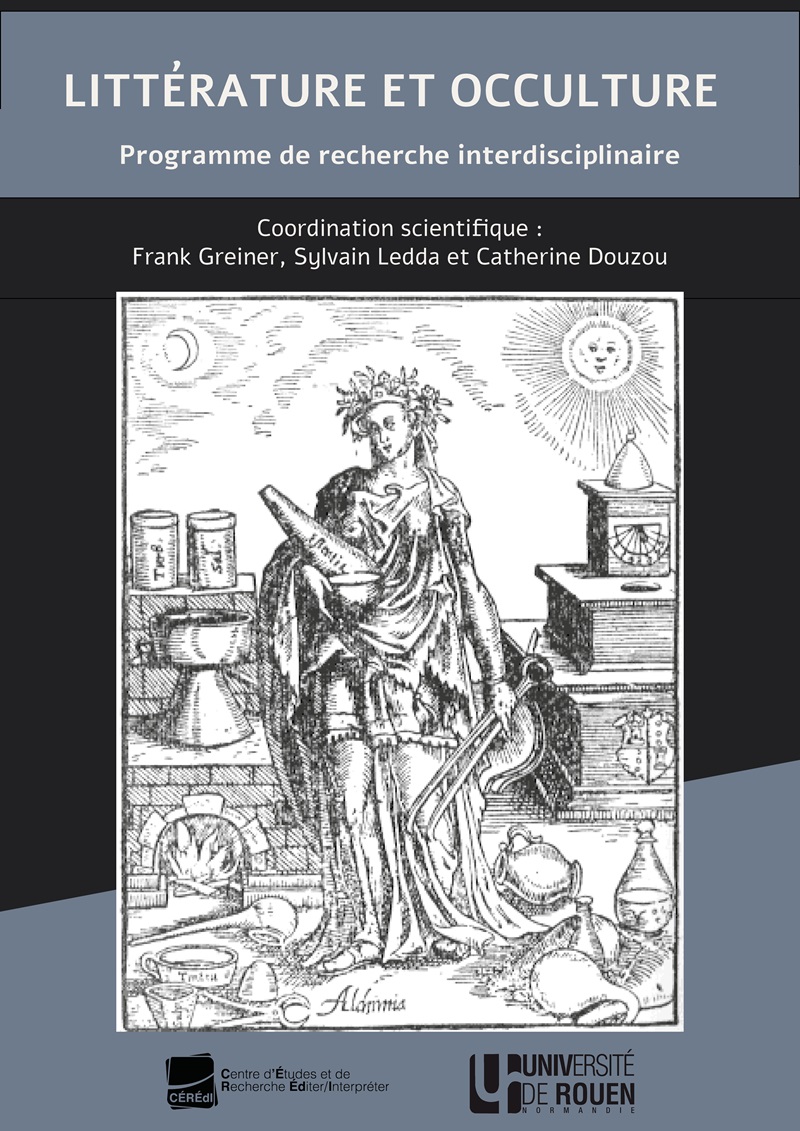
- Frank Greiner Introduction
- Tom Fischer Pantheum alchemicum, ou quand l’alchimie s’intéresse à la mythologie gréco-romaine
- Piero Latino La littérature française et l’ésotérisme de Dante
- Caroline Legrand L’arithmosophie dans Lorenzaccio : pour une herméneutique du nombre ?
- Frank Greiner À propos d’Umberto Eco et de la sémiosis hermétique
- Agnès Parmentier Quelques caractéristiques d’une herméneutique ésotérique. Le Märchen de J. W. von Goethe lu par Oswald Wirth et Rudolf Steiner
- Sylvain Ledda Présentation
- Laurence Danguy Comment regarder le tarot de Marseille ?
- Frank Greiner Court de Gébelin : du tarot au livre de Thot
- Antony Glinoer Les vies transmédiatiques des Atouts d’Ambre
- Esther Nka Manyol Les arcanes du tarot dans Sépulcre de Kate Mosse
- Stéphane Pouyaud Le crime au miroir du jeu de cartes : parties de cartes et cartomancie chez Agatha Christie
- Martin Hervé Augurer de l’écriture. La voyance littéraire d’après Sophie Létourneau et Anne-Renée Caillé
- Gwenael Beuchet Arcane 17, un essai de cartomancie objective
- Piero Latino Les arcanes majeurs selon Ouspensky, Guaita et le Père Gabriele Amorth
- Frank Greiner Prologue
- Frank Greiner Comment l’alchimie vint au roman. Nazari, Verville, Andreae et la quête philosophale
- Valérie Wampfler La Ruine de Saturne : un épisode de la Peruviana de Claude-Barthélemy Morisot, roman alchimique (1644)
- Fiona McIntosh-Varjabédian Les transmutations romanesques de Walter Scott : l’alchimie entre croyances anciennes et jugements modernes
- Tom Fischer Quel alchimiste pour les écrivains romantiques français ? Le cas Nicolas Flamel
- Piero Latino Littérature et alchimie dans le sillage d’Elémire Zolla
- Bounthavy Suvilay Fullmetal Alchemist : quand le manga s’empare de l’alchimie
- Florian Ponty Les rituels ésotériques dans la collection des Voyages imaginaires, songes, visions et romans cabalistiques
- Lise Jankovic Les rites ésotériques dans la comédie de magie espagnole du xixe siècle : du sang, du feu, des sacrifices… et du rire !
- Nemanja Radulović Kandor, or Revelation of Egyptian Mysteries (1800): An Example of Initiatic Novel in Slavic Orthodox Culture
- Yongwu Wei Exploring the Guardian of the Threshold: The Occult Reception of Edward Bulwer-Lytton’s Zanoni (1842) and its Rosicrucian Initiation.
- Jean-Michel Mathonière Les Maîtres sonneurs de George Sand, roman initiatique ou simple roman champêtre ?
- Tommy P. Cowan Castrate the Father: Lewis’s The Monk and the Devil’s Pact
- Caroline Legrand « Quelle profanation ! […] On va porter nos mystères sur le théâtre » : dévoyer les rituels maçonniques sur la scène comique (1737-1844)
- Tom Fischer Les coulisses de la messe noire dans Là-Bas (1891) de Joris-Karl Huysmans
- Nabil Sini L’initiation à travers l’œuvre de Jean Biès : de L’Initiatrice à la critique initiatique
Quatrième partie : L’écriture et la place des rituels ésotériques et/ou initiatiques dans la littérature européenne – Coord. scientifique : Tom Fischer
Exploring the Guardian of the Threshold: The Occult Reception of Edward Bulwer-Lytton’s Zanoni (1842) and its Rosicrucian Initiation.
Yongwu Wei
1Zanoni (1842), a novel by Sir Edward Bulwer-Lytton (1803-1873), former British Secretary of Colonies and writer, has long been regarded as an obscure yet captivating work. It portrays the experiences of a Chaldean initiate named Zanoni during the French Revolution – experiences that outline a series of processes referred to as “initiation” within the esoteric tradition. However, Bulwer-Lytton’s connection to Western esotericism has never been definitively established. Furthermore, the depiction of an initiation in this novel – and especially the concept of the “Guardian of the Threshold” – has been above all repeatedly appropriated by later occultists, while the deeper meaning of the novel itself has rarely been seriously examined. In this article, we shall attempt to explore the links between this British official and the French neo-hermetic tradition – with the famous Éliphas Lévi (1810-1875) having almost certainly played a key intermediary role in this regard – and to examine the possible sources of the initiatory knowledge presented in Zanoni. In the latter part of this contribution, we shall briefly outline how the concept of the “Guardian of the Threshold” was appropriated by occultists influenced by the Hermetic tradition in the 19th and 20th centuries as various authors, shaped by their respective contexts, offered diverse interpretations of this concept.
A prophetic supper: Edward Bulwer-Lytton and Éliphas Lévi
2Some scholars have already attempted to investigate the connection between Bulwer-Lytton and the French neo-hermetic tradition. The only documented account they have been able to identify so far is the reference made by Éliphas Lévi, in his Dogme et Rituel de la Haute Magie (1854), to the author’s trip to London, during which he met a man known as “Sir B----L----” and performed a ritual summoning the philosopher Apollonius of Tyana1. Although later scholars and occultists, such as Arthur E. Waite, have examined the relationship between Lévi and Bulwer-Lytton and noted that the only letter from Lévi found among Bulwer-Lytton’s papers “would appear to be addressed either to a stranger, or to a very distant acquaintance2”, the connection between the two figures may have been closer than the surviving correspondence suggests. In book I, chapter 6 of Zanoni, a scene of a “prophetic supper” is depicted: on the eve of the French Revolution, “there was a reunion of some of the most eminent wits of the time, at the house of a personage distinguished alike by noble birth and liberal accomplishments3”. Among those present were Condorcet, Malesherbes, Chamfort, and La Harpe. Furthermore, the author skilfully places the fictional character Zanoni (the main protagonist) alongside a real historical figure who played a central role at this gathering: Jacques Cazotte (1719-1792). During the supper, Cazotte made terrifying prophecies to each of the guests who had fervently championed the ideals of the Enlightenment and the values of the Revolution. In describing this scene of judgment, the editor hints:
The following prophecy (not unfamiliar, perhaps, to some of my readers,) with some slight variations, and at greater length, in the text of the authority I am about to cite, is to be found in La Harpe’s posthumous Works.4
3But who are these “some of my readers” to whom this prophecy might be “unfamiliar”? The answer may lie in the writings of Éliphas Lévi. In La Haute Magie, he suggests:
The celebrated prophetic supper of Cazotte, described by Laharpe, has not been understood yet [...]. Cazotte, the most exalted of all in the scale of initiation, pronounced their sentence of death in the name of illuminism5.
4So what is the nature of these events? To piece together the context, we might turn to a comparative reading of Zanoni and the writings of Éliphas Lévi.
5To begin with, Lévi provides, in his Histoire de la Magie (1860), the following account of the tradition to which Jacques Cazotte is said to have belonged:
The school of the unknown philosophers, founded by Pasqualis Martinez and continued by Saint-Martin, seems to have incorporated the last adepts of true initiation. Saint-Martin knew the ancient key of the Tarot – the mystery, that is to say, of the sacred alphabets and hieratic hieroglyphics […]. The Martinists were the last Christians among the Illuminists and were the initiators the famous Cazotte6.
6This account is echoed in Zanoni, in which the author refers to Martines de Pasqually and Louis Claude de Saint-Martin with great reverence:
“I will assist you. Recall the time when, led by curiosity, or perhaps the nobler desire of knowledge, you sought initiation into the mysterious order of Martines de Pasqualis”.
[ndlr: It is so recorded of Cazotte. Of Martines de Pasqualis little is known […]. Saint Martin was a disciple of the school, and that, at least, is in its favour; for, in spite of his mysticism, no man more beneficent, generous, pure, and virtuous, than Saint Martin, adorned the last century]7.
7According to Éliphas Lévi, the illuminists of the 18th century were divided into two distinct factions. One group of initiates wished to “restore the hierarchy”, while the other aimed to “level all things by disclosing the Great Arcanum, thus rendering the royalty and priesthood alike impossible in the world”. The latter group clearly alludes to the Jacobins, with figures such as Condorcet at the forefront. From Lévi’s perspective, the event of the prophetic supper thus takes on an esoteric significance: it becomes a judgment pronounced by the true initiates against the “ambitious and unscrupulous” – those who wanted to profane the Arcanum. In the novel, this moment is reimagined through the fictional character Zanoni, who guides Cazotte’s prophecy during the feast. Zanoni reminds Cazotte that the influence of Martines de Pasqually’s tradition has not yet left from him: “it is on you still – on you at this hour; it beats in your heart; it kindles in your reason; it will speak in your tongue8!”
8This comparison of the texts clearly highlights the connection between Zanoni and the French neo-hermetic tradition. It is therefore no coincidence that the novel’s plot is set against the historical context of the French Revolution. As Éliphas Lévi points out, “Cazotte foresaw Marat, as Marat in his turn foresaw a reaction and a dictator9”. Zanoni’s experience during the Revolution thus represents the dilemma faced by an initiate caught between two opposing forces – forces for which the Revolution itself serves as a symbolic battleground. In the latter half of the novel, the bloodshed and terror of the French Revolution are rendered in vivid and harrowing detail. It is against this backdrop that Zanoni, in a final act of sacrifice, goes to the guillotine to save the one he loves. Some scholars, such as John Senior and then Marie Mulvey-Roberts, have asserted that Zanoni “was modeled on the saintly Saint-Martin […] designated Reau-Croix, [who] as a crusader against charlatans was clearly an occultist of the Zanoni caste10”. This statement, perhaps unintentionally, touches upon a deeper truth. Indeed, rather than claiming that Zanoni was modelled on Saint-Martin, it would be more accurate to suggest that Zanoni and Saint-Martin both belong to the same tradition – the one attributed to Jacques Cazotte. It can reasonably be inferred that the author of Zanoni was clearly familiar with this tradition, and that the novel’s reflection on initiation may well have been drawn directly from it.
The Guardian of the Threshold in Zanoni
9In the previous section, we discussed the possible sources of Edward Bulwer-Lytton’s knowledge of initiation, as presented in Zanoni. In this part, we will introduce the most important concept related to initiation depicted in the novel – the one that has had the deepest influence on occultism: the Guardian of the Threshold. In the novel, Zanoni entrusts Glyndon (a gentleman eager for esoteric knowledge) to his fellow initiate, Mejnour, who attempts to guide Glyndon along the path of initiation. However, after a period of study, Glyndon disregards Mejnour’s warning not to open the forbidden doors. As a consequence, he encounters the Guardian of the Threshold, the embodiment of his deepest fears, which ultimately leads him to abandon his quest of esoteric knowledge:
The vapour had now assumed almost the thickness and seeming consistency of a snow-cloud; the lamps piercing it like stars. And now he distinctly saw shapes somewhat resembling in outline those of the human form, gliding slowly and with regular evolutions through the cloud. They appeared bloodless; their bodies were transparent, and contracted or expanded like the folds of a serpent […] Slowly they glided round and aloft, till, in the same majestic order, one after one, they floated through the casement and were lost in the moonlight […]. By degrees, this object shaped itself to his sight. It was as that of a human head, covered with a dark veil, through which glared with livid and demoniac fire, eyes that froze the marrow of his bones. Nothing else of the face was distinguishable – nothing but those intolerable eyes; but his terror, that even at the first seemed beyond nature to endure, was increased a thousand-fold, when, after a pause, the Phantom glided slowly into the chamber11.
10It is evident that the author devotes considerable effort to describing this fictional entity, and the level of descriptive detail achieved is one of the key factors that contributed to the widespread adoption of this theme in subsequent occultist discourse. Indeed, may esotericists appear to have interpreted this portrayal not as a mere literary fabrication, but as a reflection of a genuine initiatory experience.
11More importantly, however, the novel does not merely touch upon this theme; rather, it functions as a cautionary narrative, underlining the dangers inherent in the pursuit of esoteric knowledge and initiation – dangers that are, at times, explicitly linked to death. In particular, Glyndon’s reckless transgression leads to the tragic and unjust death of his sister, Adela. The malevolent force he inadvertently unleashes does not simply vanish; instead, it permeates his life and ultimately claims the person who cared most for him:
He rose – he approached her. Adela started up, “Look–look–look!” she exclaimed. “She comes! Save me–save me!” and she fell at his feet in strong convulsions; as the clock, falsely and in vain put back, struck the half-hour.
The physician lifted her in his arms. “My worst fears are confirmed”, he said, gravely; “the disease is epilepsy”. [ndlr: The most celebrated practitioner in Dublin related to the Editor a story of optical delusion, precisely similar in its circumstances and its physical cause to the one here narrated]12.
12Drawing upon the above passages, we can observe that the experience of the Guardian of the Threshold is often associated with intense fear. At the same time, it appears to be interpreted, at least on the surface, as a physiological disorder, or as something closely resembling the symptoms of such a condition. Here, we can expect some of the ways in which occultism appropriates this theme: many occultists associate the experience with fundamental human fear, while others interpret it in relation to certain psychological symptoms. In the following discussion, we will examine the extent to which these divergent appropriations reflect the distinct characteristics of different esoteric movements.
The appropriation of the Guardian of the Threshold in occultism
13As mentioned above, we have already referred to the possible connection between Edward Bulwer-Lytton and the French neo-hermetic tradition. It appears that French occultism, influenced by Éliphas Lévi, made extensive use of the concept of the Guardian of the Threshold. For example, the famous Papus (Gérard Encausse, 1865-1916) states this clearly in Le Tarot des Bohémiens (1889):
The reader cannot pay too much attention to this solemn moment of practical occultism, so well described in Lytton’s novel (Zanoni) under the name of the Dragon of the Threshold; it is the formidable danger which necessitates so many secrets13.
14There is no doubt that Papus attached particular importance to the dangers of initiation and regarded the concept of the “Dragon of the Threshold” as one of the main reasons why initiation had to remain secret – otherwise, an ignorant apprentice who ventured down this path might face extremely terrifying consequences. This awareness of the danger posed by the Guardian of the Threshold clearly echoes the description of the terrifying experience endured by Glyndon in Zanoni. Subsequently, one of Papus’s friends, Stanislas de Guaita (1861-1897), also made explicit reference to the Guardian in his work:
There is a door, as we shall see, that cannot be crossed without coming into contact with certain forces, of which one inevitably becomes either the master or the slave, the guide or the plaything […]. The readers of Zanoni – the beautiful novel by Sir Bulwer Lytton – may have guessed, in the “unnameable monster” that Glyndon evokes so unfortunately, a myth similar to that of Genesis. – The “horrible and veiled Thing”, the “Guardian of the Threshold”, it is the fluidic soul of the Earth, the unconscious spirit of birth and death, the blind agent of Eternal Becoming14.
15However, he clearly reinterpreted this concept within the framework of a more elaborate occult theory. Guaita described it as “the fluidic soul of the Earth, the unconscious spirit of birth and death, the blind agent of Eternal Becoming”: these descriptions clearly reflect the influence of Éliphas Lévi. Thus, Guaita sought to understand the Guardian of the Threshold through Lévi’s theories on astral light and universal agency.
16Furthermore, it was through the Theosophical Society, founded by Helena P. Blavatsky (1831-1891), that the term gained wide currency. In Isis Unveiled (1877), Madame Blavatsky remarked:
Such is the origin of the serpent, metamorphosed in Christian ages into Satan. It is the Od, the Ob, and the Aour of Moses and the Kabalists. When in its passive state, when it acts on those who are unwittingly drawn within its current, the astral light is the Ob, or Python […]. Bulwer-Lytton calls in Zanoni “the dwellers of the threshold15”.
17Unlike French occultists, she tended to interpret the Guardian of the Threshold in an archetypal fashion, associating it with the serpent of Genesis or even with Satan. It is clear, however, that she also adopted the theoretical framework of astral light and understood this concept as the astral light itself. On the other hand, there is no doubt that Blavatsky emphasises the truthfulness of this description, presenting it more as a recollection of experience than as a product of imagination. But a more comprehensive study of this topic comes from the anthroposophist Rudolf Steiner (1861-1925):
[…] Anyone seeing his unredeemed Karma, without adequate preparation, appear as a living physical creature before his eyes, would run the risk of erring into evil byways. Bulwer Lytton’s Zanoni in the form of a novel contains a description of the Guardian of the Threshold16.
18Rudolf Steiner refers to it as “unredeemed karma”, which corresponds to a more personalised interpretation. Unlike French occultism or theosophy, which regard it as a kind of cosmic force, Steiner seemed more interested in its impact on the individual’s spiritual law. In this sense, his interpretation of the Guardian of the Threshold is more firmly rooted in individual initiation – what he called “the path to the higher knowledge”. Subsequently, Rudolf Steiner’s followers continued along these lines, viewing the Guardian of the Threshold as a more personalised, even psychological, force. For example, one might specifically highlight the different descriptions of “Guardians of the Threshold” in various contexts, which may be linked to the experience of unpleasant sensations during meditation, nightmare experiences, or sleep paralysis.
19Valentin Tomberg (1900-1973), perhaps the most important hermeticist of the 20th century, inherited the interpretations of the Guardians of the Threshold from occultism, theosophy and anthroposophy, while endowing the concept with an entirely new meaning. In his Meditations on the Tarot (1972), he wrote:
The “guardian of the threshold” figures in the tradition (including more recent contribution to the tradition) either as a kind of double incorporating the whole past of the person in question, or also as a hierarchical entity of the rank of an Archangel who teaches the lesson of conscience by means (this is only one means) of projecting the double of the human personality aspiring to the “depth world”. […] At least, such is the evidence of the experience of five people of this century known to me17”.
20It is worth noting that Tomberg placed particular emphasis on “the lesson of conscience”, a dimension rarely addressed in previous interpretations. According to his view, consciousness plays a pivotal role in the transition from the “surface world” to the “depth world”. Thus, the encounter with the Guardians of the Threshold is understood as a revelation of one’s “personal conscience”, or even of “the truth concerning oneself”. From this perspective, the terrifying visions experienced by the individual when encountering the Guardians on the path of initiation are no longer regarded merely as a danger, but rather as a trial – a test of one’s own cons consciousness. It is only by passing this trial that one can be granted entry into the “depth world”. Therefore, Tomberg believed that “the guardian of the threshold is not a moral bogey for bowling over the ‘spiritual bourgeoisie’, but rather our elder brother and servant of God, who helps us with infinite kindness and superhuman wisdom18”.
21As this analysis has shown, through successive reinterpretations by later occultists, the concept of the “Guardian of the Threshold” has become increasingly concrete: starting as a literary image drawn from a novel, it has gradually become associated with various esoteric currents and has thus been endowed with meanings that were both distinct and intrinsic. These connotations reflect the reinterpretation and appropriation of the tradition by modern occultism after the 19th century – from the introduction of theory of astral light to reflections on mental illness (as in anthroposophy), and even the renewed alignment of the Hermetic tradition with Christian theosophy (such as the emphasis on conscience in Tomberg’s work). Ultimately, this article attempts to situate Edward Bulwer-Lytton within a context referred to as the “initiation tradition”, a interpretative framework which perhaps in itself reflects the inherent complexity of contemporary studies on esotericism. As the scholar Christopher McIntosh has noted, “sooner or later, anyone studying these subjects [esotericism] from an academic point of view has to make the decision whether they are going to take a personal stance for or against19”. In other words, our aim is to establish a connection between Zanoni and the more profound esotericism, and even modern occultism – despite the fact that such a connection (much like Bulwer-Lytton’s own relationship to esotericism) is still not supported, to this day, by factual evidence.
22We can also observe that, despite their differing emphases, all occultists seem to implicitly accept a “traditional” narrative – namely, the existence of a universal tradition of initiation. This tradition encompasses both a cosmological dimension (as articulated by Madame Blavatsky) and a dimension of personal experience (as emphasized by Rudolf Steiner and Valentin Tomberg). The “Guardians of the Threshold” can therefore be regarded as a universal experience within this tradition. When one speaks of “universality”, we must acknowledge that, in the context of occultism, the appropriation of this concept should not be viewed merely as a personal appropriation of Zanoni as a work of fiction. More importantly, this suggests that occultists, each through their own unique journey, may have drawn upon this “universal experience” – and that they found, in this novel, a sincere and profound reflection of it. In any case, we can only catch glimpses of the sources of this “initiation tradition” in Zanoni, but this is precisely the allure of esotericism. Those who belong to this tradition almost always embody a certain “paradoxical” quality. As McIntosh aptly puts it: “A man can be at the same time a cheap charlatan and a purveyor of the greatest wisdom20”. This very quality functions like a kind of “Guardian of the Threshold” itself, constantly testing scholars and readers who seek to understand its deeper meaning.
1 See for example Christopher McIntosh, Eliphas Lévi and the French Occult Revival, Albany, State University of New York Press, 1972, p. 96-104.
2 Arthur E. Waite, The Mysteries of Magic, A Digest of the Writings of Eliphas Lévi, With Biographical and Critical Essay, London, Georges Redway, 1886, p. XV.
3 Edward Bulwer-Lytton, Zanoni, London, Saunders & Otley, 1842, t. I, p. 57.
4 Ibid., p. 64, n.
5 Éliphas Lévi, Dogme et Rituel de Haute Magie, Paris, Germer Baillière, 1861 (or. ed. 1854), t. I, p. 323-324 (personal translation).
6 Éliphas Lévi, Histoire de la Magie, Paris, Germer Baillière, 1860, p. 435 (personal translation).
7 Edward Bulwer-Lytton, Zanoni, op. cit., t. I, p. 62.
8 Ibid., t. I, p. 63.
9 Éliphas Lévi, Histoire de la Magie, op. cit., p. 437 (personal translation).
10 Marie Roberts, Gothic Immortals, The Fiction of the Brotherhood of the Rosy Cross, London/New York, Routledge, 1990, p. 158.
11 Edward Bulwer-Lytton, Zanoni, op. cit., t. II, p. 208-210.
12 Edward Bulwer-Lytton, Zanoni, op. cit., t. III, p. 25.
13 Papus [Gérard Encausse], Le Tarot des Bohémiens, Le plus ancien livre du monde, Paris, Ernest Flammarion, 1889, p. 277 (personal translation).
14 Stanislas de Guaita, Essais de sciences maudites, I – Au seuil du mystère, Paris, Georges Carré, 1890 (or. ed. 1886), p. 15 (personal translation).
15 Helena P. Blavatsky, Isis Unveiled, A Master-Key to the Mysteries of Ancient and Modern Science and Theology, New York, J. W. Bouton, 1877, t. I, p. 157-158.
16 Rudolf Steiner, Knowledge of the Higher Worlds and its Attainment, edited by Harry Collison, New York, AnthropoSophic Press, 1932 (or. ed. 1904), p. 193.
17 Anonymous [Valentin Tomberg], Meditations on the Tarot, A Journey into Christian Hermeticism, New York, Amity House, 1985 (or. ed. 1972), p. 512.
18 Ibid., p. 512.
19 Christopher McIntosh, The Rosicrucians, The History, Mythology, and Rituals of an Esoteric Order, York Beach, Weiser Books, 1997, p. XV.
20 Ibid., p. 139.
Programme de recherche
Coordination scientifique : Frank Greiner, Sylvain Ledda et Catherine Douzou
© Publications numériques du CÉRÉdI, « Actes de colloques et journées d’étude », n° 29, 2023
URL : https://publis-shs.univ-rouen.fr/ceredi/2213.html.
Quelques mots à propos de : Yongwu Wei
Bamberg University