
Sommaire
7 | 2026
Romantic Offshoots: Reassessing the Legacy of British Romanticism
The aim of this volume is twofold: first, to open up a space for the reassessment of artworks which hark back to, riff on, pay homage to, or uproot their Romantic precursors, while also teasing out some of the more oblique correspondences or affinities between British Romanticism and its descendent forms; and, second, to reexamine the notion of literary inheritance itself, as it pertains to such works – particularly the ways in which many twentieth- and twenty-first-century works willfully enter into an ambiguous relationship with the Romantic tradition. This special issue is itself an offshoot of a research collaboration between ERIAC (Université de Rouen Normandie) and ERIBIA (Université de Caen Normandie). The articles gathered here address the ways in which Romantic-period ideas or models have been reanimated in the light of contemporary concerns, in still-evolving genres (such as sci-fi and dystopian climate fiction, neo-historical biopics, or pop and rock music) and across different media (including graphic novels, television series, and video games), as well as in more traditional forms.

- Jeremy Elprin et Oriane Monthéard Introduction to Romantic Offshoots: Reassessing the Legacy of British Romanticism
- Nathalie Cochoy « Darkling I listen » : l’art du renoncement dans The Great Gatsby et Tender Is the Night, de F. Scott Fitzgerald
- Jeremy Elprin On Not Giving Up the Ghost; or, the Ambivalent Post of Keats’s Letters in Contemporary Fiction
- Caroline Dauphin A Genealogy of the Polypus, from William Blake to H.P. Lovecraft: The Root of All Evil?
- Janneke van der Leest Romantic Mourning for Young Deceased Rock Artists
- Fabien Desset William Blake, Karfagen and Romantic Innocence
- Cal Sutherland “Take me to the Lakes”: Romantic Retreats in Lyrical Ballads and the Lyrics of Taylor Swift
- Armelle Parey Romanticising Women Writers in Biopics: Mary Shelley (2017) and Emily (2022)
- Camille Adnot Mycological Fears: Fungi and Ecological Anxiety from Linnaeus to The Last of Us
- Aurélie Thiria-Meulemans Planting the Seeds of Post-Apocalyptic Fiction: The Legacy of Byron’s “Darkness” and Cain, A Mystery
7 | 2026
William Blake, Karfagen and Romantic Innocence
Fabien Desset
Cet article étudie l’adaptation de deux poèmes de Chants de l’Innocence (1789) de William Blake, « The Ecchoing Green » et « Spring », ainsi que le fragment « Eternity », par le groupe de rock progressif ukrainien Karfagen et son compositeur principal Antony Kalugin, sur l’album Birds of Passage (2020), dont le titre est également emprunté à un poème de Henry Wadsworth Longfellow. Cette étude transtextuelle montre que, même si les poèmes ne sont pas modifiés en profondeur, ils sont néanmoins réécrits, comme l’association des deux poètes le présuppose déjà, afin de correspondre à la musique de Kalugin et à son thème de l’envol pour le monde plus paisible de l’innocence. Cela conduit aussi à s’interroger sur les motivations du compositeur et à se demander jusqu’à quel point ses albums composés entre 2019 et 2023 peuvent s’inscrire dans la tradition romantique.
This article examines the adaptation of two poems from William Blake’s Songs of Innocence (1789), “The Ecchoing Green” and “Spring”, plus the fragment “Eternity”, by the Ukrainian progressive rock band Karfagen and its main composer, Antony Kalugin, in the album Birds of Passage (2020), whose title is also borrowed from a poem by Henry Wadsworth Longfellow. This transtextual study shows that, although Blake’s poems are not fundamentally altered, they are nonetheless transformed, as the association of the two poets already suggests, to fit Kalugin’s music and the theme of flight to the safer world of innocence. This also raises the question of the composer’s motivations for using these poems and of the extent to which his work composed over the 2019-2023 period can be considered as a Romantic offshoot.
Introduction: William Blake, Rock and Karfagen
1William Blake is probably the most influential of all Romantic poets in rock music, from folk-rock (Van Morrison, “Let the Slave,” A Sense of Wonder, 1984)1 to black and industrial metal (Ulver, Themes from William Blake’s Marriage of Heaven and Hell, 1998).2 Rock musicians are firstly fascinated by this archetype of the complete artist, being both a poet and painter, not to mention a professional engraver. The visual aspect is indeed paramount in pop-rock music, on stage as well as on the album sleeves and promotional photos. It is even truer of progressive rock and heavy metal, when the bands take their listeners to other worlds, Hell included, in a “spontaneous overflow of powerful feelings,” as William Wordsworth puts it in his 1802 preface to Lyrical Ballads.3 Atomic Rooster, for instance, chose the engraving Nebuchadnezzar (1793), a reworking of plate 24 of The Marriage of Heaven and Hell (1790),4 as a cover for their second 1970 album, Death Walks Among You.5 Blake’s archetypal dimension may be reinforced by his biography, particularly his so-called “visions”: the line between the artist and man then appears very fine. Blake is also a two-sided poet, the poet of the “prophetic books,” sometimes written in prose, and the poet of the “songs of innocence,” whose apparent simplicity accounts for the popularity of his Songs of Innocence and of Experience (1794), his most adapted collection of poems, even before the prophetic Marriage of Heaven and Hell. A glimpse at lieder.net shows dozens of musical adaptations from the end of the nineteenth century onwards, in classical music especially.6 Of course, the Songs’ being ballads facilitated the transition from poetry to music.
2Progressive rock appeared in the UK at the close of the 1960s and sought to experiment with long and complex musical structures, various instruments and effects, and themes ranging from fantasy, as best exemplified by Roger Dean’s covers for Yes, to ecological and social concerns. Karfagen is one of the multiple musical projects of Ukrainian composer, keyboard player and singer Antony Kalugin, whose career began in 2002, at a time when prog rock had been a niche market for twenty years already. Kalugin claims to have been influenced by Peter Gabriel’s (early) Genesis, Mike Oldfield and Frank Zappa,7 but his adaptations of Blake’s poetry are also reminiscent of the dream-like progressive music of Yes, as the booklet’s illustrations, a combination of natural and fantasy themes, show. Folk music and symphonies are other sources of inspiration. The music of Karfagen is thus characterised by imagination, transcendence, epic outbursts, as well as a certain softness and return to innocence, that of children and Romantic nature. The choice of Songs of Innocence, rather than the Songs of Experience or the more “adult” Marriage of Heaven and Hell, already suggests Kalugin’s main interest, innocence.
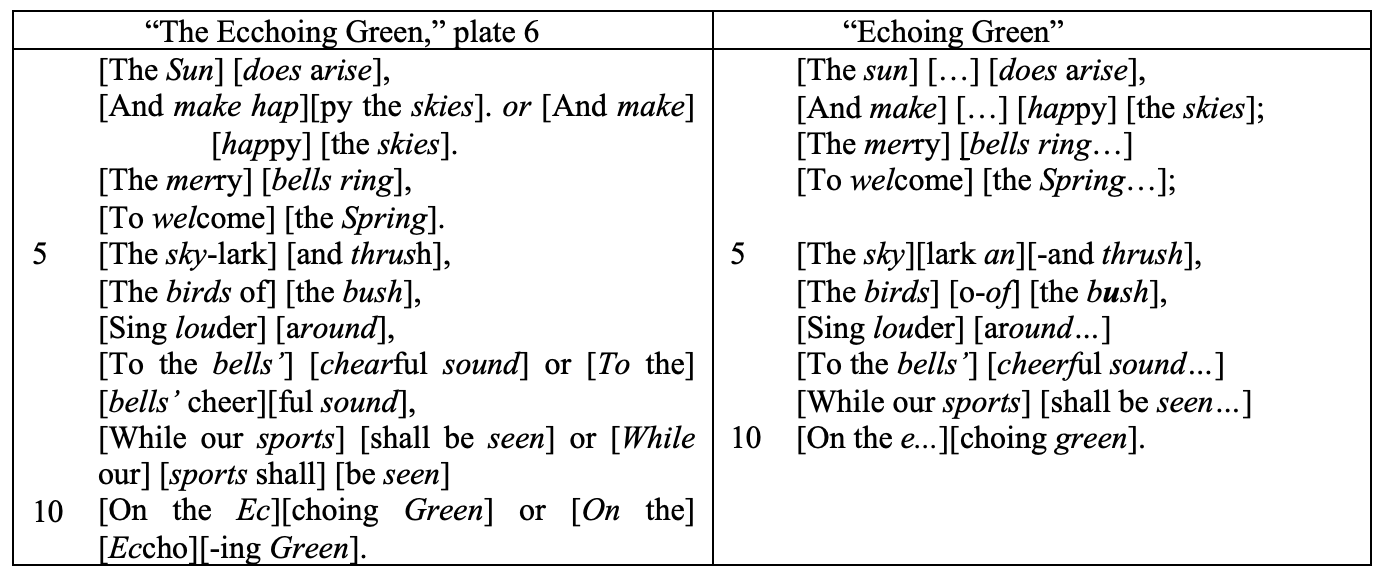
3With Blake, innocence is, however, often threatened by more adult concerns, and indeed, some of the songs have changed series, like “The Tyger.” This study will consider whether “experience” similarly threatens “innocence” in the musical adaptations. Furthermore, Blake’s poems may be modified by their juxtaposition, even intermeshing, with Henry Wadsworth Longfellow’s poetry, from which the title of the album under study, Birds of Passage (2020),8 is borrowed. If innocence is the main theme, then, how far is Blakean innocence contaminated, in Gérard Genette’s sense of the term,9 by Longfellow’s poetry? Although Genette has qualms about such a transaesthetic approach, because literary critics may lack the knowledge of other aesthetic fields (in this case, music), his terminology and focus on formal and thematic transpositions will nonetheless prove useful, as the idea of contamination already shows. Finally, Kalugin is above all a musician, who has released instrumental albums, including an instrumental version of Birds of Passage, Birds (as a bonus disk for Passage to the Forest of Mysterious, 2023).10 Thus, beyond the theme of innocence, there may also be more pragmatic reasons for choosing poems over original lyrics. After an overview of Kalugin’s motives and a presentation of the structure of the album, this article will attempt to answer those questions by analysing the adaptation of Blake’s poems, “Eternity,” “The Ecchoing Green” and “Spring.”
Flight, Innocence and the Structure of the Album
4Kalugin often shares the English songwriting with the Welsh musician William Mackie, the coproducer of some of his records, including Birds of Passage, as English is not his mother tongue. Choosing copyright-free literary texts may thus first result from a linguistic issue. It is, however, only lately, after twenty years of songwriting, that Kalugin chose to use poems like Robert Louis Stevenson’s A Child’s Garden of Verses (1885) on his previous album, Echoes from within Dragon Island (2019).11 His motives were therefore not purely linguistic.
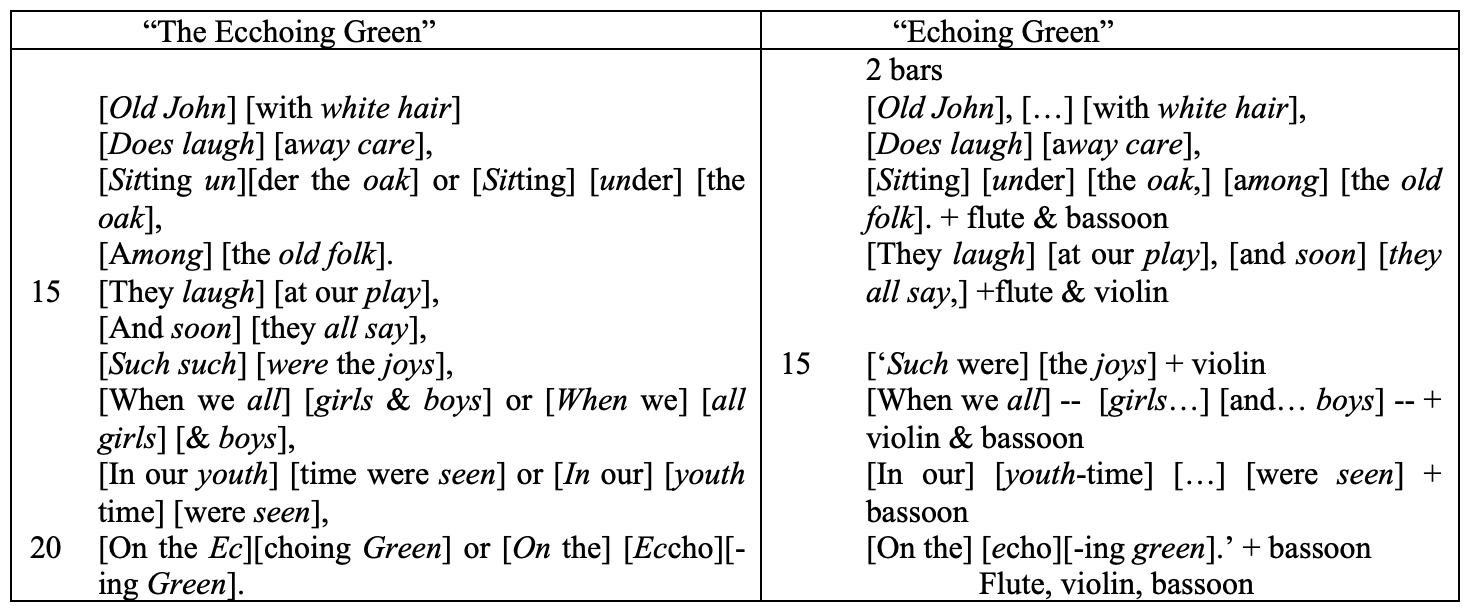
5The question may also be asked whether adapting Blake’s Songs really resulted from genuine inspiration, as Van Morrison, Jah Wobble and Kalugin (“Based on Henry Wadsworth Longfellow’s and William Blake’s poetry”)12 ostensibly claim, or from a desire for higher-brow cultural respectability (see the phrase “metallectual rockers” used by C. Klosterman for Iron Maiden).13
6If the critical success of Echoes from within Dragon Island and Birds of Passage may have encouraged Kalugin to go on using Blake’s poems, like “The Blossom” on the “Bonus Disk” to The Land of Green and Gold (2022)14 and “Auguries of Innocence” on Passage to the Forest of Mysterious, critical success and financial success are far from synonymous for a Ukrainian progressive rock band. Besides, the last albums contain little adaptation of literary texts, which suggests that the 2019-2023 period was a special time of “influence” and experimentation.
7Whatever prestige is conferred by the “grand old masters,” as Longfellow puts it in “The Day is Done” (1844),15 the artistic quality is usually enhanced by the use of their poetry: despite the apparent simplicity of Stevenson’s A Child’s Garden of Verses (1885), Longfellow’s “Birds of Passage” (1845) and Blake’s Songs of Innocence, there is an originality in them that transcends the commoner metaphors and themes sometimes found in pop music in general. There is also a quaintness in old poems that fits the escapist flight from everyday reality of Karfagen’s progressive rock. Although the subsequent instrumental versions suggest that the music was already self-sufficient and that the poetry was only the final touch, the playful experimental dimension in adaptation, with text and music possibly influencing one another, is also apparent.
8Above all, it is the theme of innocence and the dream or natural world associated with it which are most relevant here: even though the inevitable variations in moods in twenty-minute long tracks allow for a little melancholy and relative aggressivity sometimes, the transposition of Stevenson’s A Child’s Garden of Verses had already shown a desire to fly away from everyday reality, indeed darkened by the Russian invasion of Ukraine, which had already started in 2014 (Crimea and Donbas). Blake’s “innocence,” like Stevenson’s “child’s garden,” again provides Kalugin with a wistful refuge, while Longfellow’s “flights,” as the American poet calls his series of “Birds of Passage” poems, emphasise escapism and transcendence. Innocence, imagination and nature are things that matter to the composer, as they did to the Romantics, and quoting these poets allows Kalugin to reaffirm his affinity with Romantic ideas.
9Birds of Passage is divided more or less equitably between Longfellow and Blake. The title refers to the former’s eponymous poem and his five subsequent series subtitled “Flight[s].” Whereas Longfellow’s original poem refers to literal migratory birds, the subsequent “Birds of Passage” poems refer to the verse occupying literary magazines “temporarily,” like people staying in one place for only a short time. Kalugin only refers to the original literal meaning but the birds are also symbolic of nature, childhood and imagination, as their humanisation in the booklet’s illustrations, where they are dressed and stationed in the natural environment of a fruit village, already suggests. The “Making of Birds video footage” on Birds, showing Kalugin’s infant son in his pram marvelling at the forms drawn by a flock of birds in the sky, reinforces the connection between birds, nature and innocence. The “syncretic” association, between an American poet from the second half of the nineteenth century and an English one from the late eighteenth century, is therefore less surprising. Still, this juxtaposition, within a concept album, transforms the two series of poems, as in Genette’s “minimal parody”16: the very connection between Blake and Longfellow is a reinterpretation that, here, “revalues”17 nature (Longfellow’s “linden trees”, Blake’s “oak”) or animals (Longfellow’s birds, Blake’s lamb), and modifies their symbolism; birds of passage are now symbolic of innocence, and innocence is represented by birds of passage. Indeed, there are also birds in each of Blake’s poems, although they are not all migratory nor literal, such as the “winged life” and “joy as it flies” in “Eternity,” from the “Rossetti Manuscript” (ca. 1789-1793), the skylark and thrush in “The Ecchoing Green,” as well as the lark and nightingale in “Spring.”. Therefore, it is also less surprising that Blake’s poems should constitute the “Birds of Passage (Part 2)” section of the album, but their being subsumed in Longfellow’s (literal) theme somewhat changes their meaning. Even within the Blakean half of the album, the selection and grouping of poems whose (reworked) titles are “Eternity[’s Sunrise],” “[The] E[c]choing Green” and “Spring [(Birds Delight)]” revalue the theme of undying childhood or innocence, another minimal parody resulting from this new context. This is already a “rewriting” of Blake’s poems. The structure of the album further shows the “intercontamination” of the two poets.
10Typically, the “symphonic art rock suite,” as the album is called on its back cover, is made up of several “parts,” which turns it into a concept album, that is to say, not a collection of unconnected songs, but a series of tracks narrating the same story or illustrating a common theme. “Birds of Passage (part 1)” (22:40) is made up of three poems, Longfellow’s “Birds of Passage,” “Daybreak” (1858) and “The Day is Done” (1844, 1846), the last of which only providing an instrumental subsection with its title (ironically, “The Day is Done” was to be sung on the instrumental Birds). They are preceded by “Your Grace,” curiously retitled “Sounds that Flow” (from line 26 of “Birds of Passage”) in its first iteration but then left untitled in its second one. As a note indicates in the booklet, “Your Grace” was written by Kalugin himself. It serves as a “meta chorus” for the whole album and connects the two poets together, since it is repeated a third time, untitled again, in the Blakean “part 2.” “Birds of Passage (part 2)” (21:11) indeed combines Blake’s “Eternity” and “The Ecchoing Green” with these original lyrics and two instrumental subsections, whose titles are again drawn from Longfellow’s “The Day is Done.” In addition to these two main parts, there are two “bonus tracks,” “Spring (Birds delight)” (4:34), which adapts “Spring,” and the instrumental “Sunrise” (5:23), whose title refers to “Eternity,” which Kalugin had retitled “Eternity’s Sunrise” in part 2. Kalugin goes on with the same theme and the same moods, and, indeed, these bonus tracks were to be incorporated in the main work in the instrumental version Birds, as “Birds of Passage (part 3).” Therefore, although Blake’s poems are subsumed under Longfellow’s titular theme, they are far from underrepresented.
“Eternity’s Sunrise” and “Echoing Green”: Flying Away from the Care of Experience
11The first sub-part of “Birds of Passage (part 2),” “Eternity’s Sunrise,” is not an adaptation of a song of innocence, but of the fragment “Eternity” from the “Rossetti Manuscript,” the notebook which had once belonged to Blake’s brother, Robert, and which the poet mainly used between 1789 and 1817:
He who binds to himself [to] a joy
Does the winged life destroy[;]
But he who [just] kisses the joy as it flies
Lives in [an eternal] eternity’s sun rise[!]18
12In Kalugin’s version, the absence of the three bracketed lexical variants19 and the addition of the semi-colon suggest that Kalugin used the poetryloverspage.com website.20 The “Making of Birds” video indeed shows him holding a printed sheet of Longfellow’s “Birds of Passage” whose design is the same as on the website, where the other poems can also be found, including Stevenson’s “A Child’s Garden of Verses.” He only substitutes an exclamation mark for the final full stop, and the compound “sun rise” is either spelt in two words, as in Blake’s poem, the title on the back cover of the CD digipack and on the bandcamp version, or in one word, as in the title and lyrics within the CD booklet, and the title of the bonus track instrumental both on the back cover and in the booklet. The typographic variations thus show a tendency to modernise the hypotext.
13Alicia Ostriker21 indicates that the notebook contains drafts of most of the Songs of Experience (1794), but if there are stylistic similarities with “To Tirzah” or “The Human Abstract,” the epigrammatic style of this unique quatrain is more akin to the axioms of “Auguries of Innocence.” Indeed, there are similar rhyming couplets in that longer poem starting with “He who,” like “He who respects the Infant faith / Triumphs over Hell & Death” (89-90),22 which can be related to innocence, but the theme of obsession in “Eternity” also recalls what Blake says a few lines below, “To be in a Passion you Good may do / But no Good if a Passion is in you” (111-112). These are actually the lines chosen by Kalugin in Passage to the Forest of Mysterious, which shows the relevance of the theme of obsession to him, as an artist, as well as his preference for psychological maxims over political, religious or social ones. The rhyming couplets of the quatrain also match Longfellow’s, while the objectifying bird-like metaphors of “the winged life” and “joy as it flies” echo the American poet’s “The sound of winged words” in “Birds of Passage,” as well as “Those sounds that flow / In murmurs of delight / Come not from wings of birds,”23 which Kalugin repeated as the inner chorus to that first song. Therefore, the inclusion of the fragment in the selected Songs of Innocence may, at least in part, be due to its stylistic similarity with Longfellow’s poem.
14“Eternity’s Sunrise” is introduced by Aleksandr Pavlov’s nylon guitar arpeggios, which are mid-way between a lullaby and a solo recital evoking innocence and nature. A few delicate notes of piano add a little melancholy, but when Maria Baranovska’s violin chords cause the rhythm to speed up, there is a playful, almost mischievous, feeling in all the instruments. At 4:51, Mathieu Spaeter’s electric guitar riff, punctuated by Viktor Syrotin’s drums, including the cowbell, really launches the song, which then evokes a playful march, while Kalugin’s synthesiser opens the doors of imagination. The sampled sound of wind in the background already heralded that transcendence or referred to the sky, the realm of birds. After a crescendo, the music slows down, with the nylon guitar again in the foreground, but playing rhythmical chords this time, apparently accompanied by a violin-sounding mellotron and a flute whose theme recalls “Your Grace” in the preceding part.
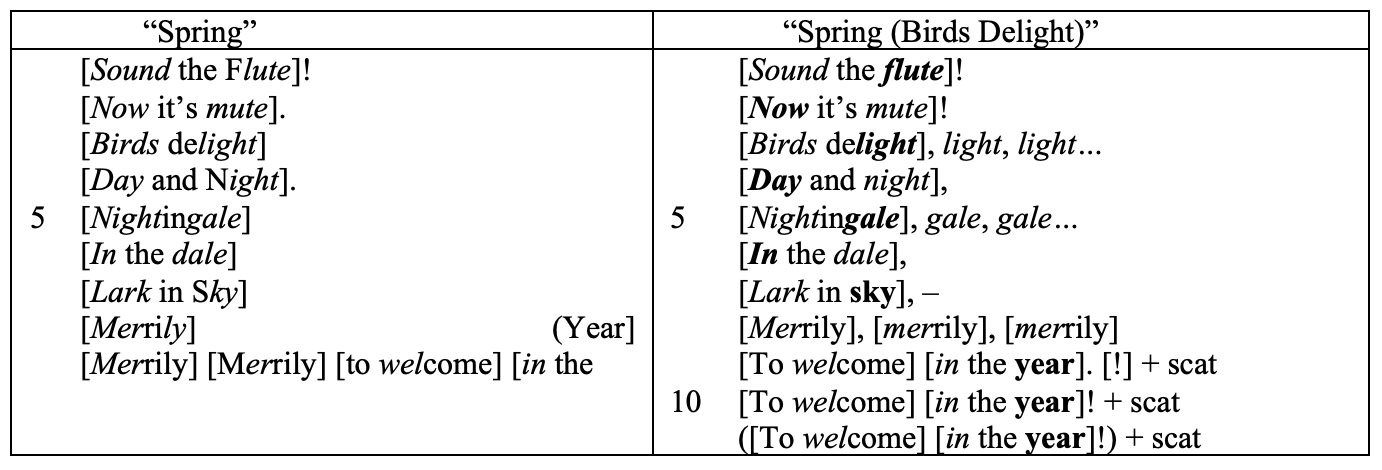
15Whereas the music (re-)introduces the idea of innocence in all its delicate, playful and imaginative aspects, suggesting that the Songs of Innocence (rather than the fragment) might well have inspired it, the radio-like treatment of the voice that follows is, at best, puzzling. It causes the voice to sound distant and subdued, probably to mark the difference between this quatrain, which is not part of the Songs of Innocence and deals with the adult theme of obsession or possessiveness, and the lighter poems to come. The heterogeneity of the voice also works as a heterodiegetic narrator introducing his story, as in Percy Bysshe Shelley’s “Alastor” (1815), for instance. The singing also sounds almost plaintive, which contrasts with the playful feel of the music, unless Kalugin wished to maintain a certain delicate innocence through it. The symphonic coda to that subpart, introduced by a crescendo and closing on a decrescendo of the electric guitar, is however ample and dramatic, illustrating the transcendence of “eternity” but also sounding like a serious warning that better fits the adult theme of the fragment. So, while the introduction suggests the theme of innocence, the singing and end better correspond to the serious fragment; as in Blake’s Songs of Innocence, innocence is threatened by experience. Still, although Blake deals with possessive obsession, the negative aspect of the verbs “binds to” and “destroy” is already overcome in the poem by the positive dimension of “joy,” indeed mentioned twice, and by transcendence, on which the fragment closes. Even more so, Kalugin’s addition of the exclamation mark and fading out “sunrise” echoes, as well as his change of title into “Eternity’s Sunrise” and then, in the bonus instrumental, “Sunrise,” revalue the lighter dimension of the last two lines. It is thus more likely that, despite the singing and dramatic coda, Kalugin above all focused on joy, and used the fragment as an epigraph to a part that mostly deals with that theme. If experience is introduced with the fragment, it is quickly swept away.
16The symphonic finale of “Eternity’s Sunrise” comes to an end, but the Hammond organ’s last chord bridges the gap with part b, “Echoing Green,” which starts right away at 7:13. It is introduced by a fast, playful series of keyboard and then electric guitar crescendos and decrescendos, before another mid-tempo march-like melody, during which the keyboard and guitar emulate one another, which suggests a less innocent mood, as though children running all about had been replaced by more demure teenagers. The keyboard’s coda to that musical introduction yet re-establishes the nature and imagination feel of the start of part 2, a mood reinforced by Elena Kushiy’s flute, which accompanies Kalugin’s voice. The instrument recalls the “pipe” in the “Introduction” proem (plate 4) to The Songs of Innocence: “Drop thy pipe thy happy pipe / Sing thy songs of happy chear” (9-10). However, on the frontispiece (plate 2) that illustrates “Introduction,” as the latter’s text occupies most of the plate 4, the instrument with its flared end looks more like an oboe. On the previous album, which was even more symphonic, Kalugin had used an English horn, which may look like a clarinet, but on Birds of Passage, there are only a flute and penny flute (as well as a bassoon). The absence of an oboe or clarinet may be a clue that the music was composed before the choice of Blake’s poems. However, the flute is often associated with birds, hence its use in the Longfellowian first part, and pastoral nature.
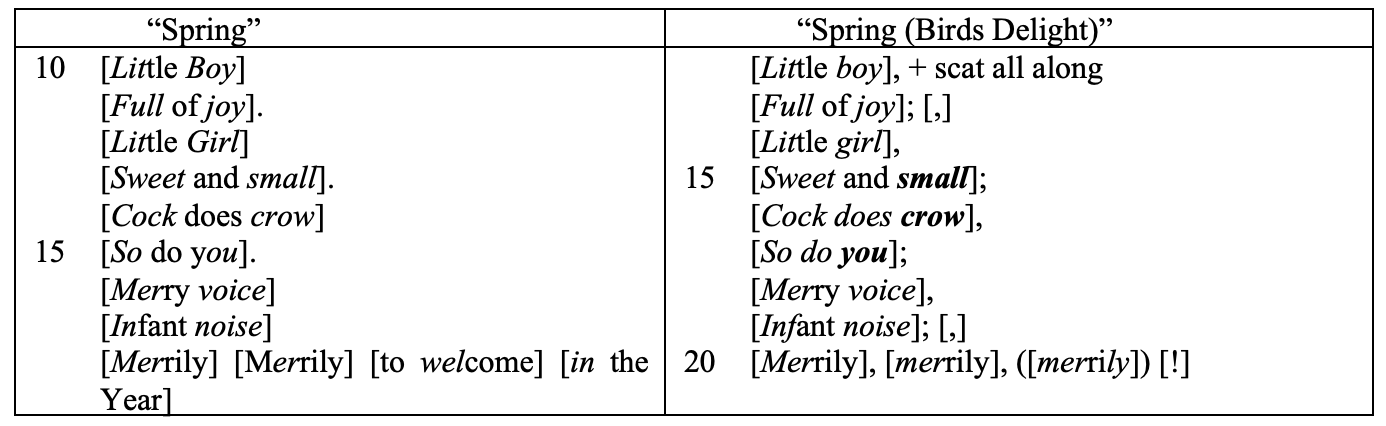
17Indeed, because of its birds, “Echoing Green” fits in well with Birds of Passage. Contrary to Longfellow, however, Blake names those birds, so there is further symbolism: the “sky-lark” (5) in this poem and in “Spring” (“Lark in sky,” 7) and the “nightingale” in the latter (5) represent “Day and Night” (“Spring,” 4), respectively, or sunrise and sunset, so that the skylark further connects “Echoing Green” to “Eternity’s Sunrise.” When night falls in “The Ecchoing Green,” however, Blake does not refer to the nightingale, but to “birds in their nest” (27), to which the children are compared, another connection between birds and innocence, as in Kalugin’s video on Birds. The “thrush” is also associated with the skylark and “The birds of the bush” (6), which thus embody dawn, joy and innocence, as well.
18The first line, “The sun does arise,” further connects “Echoing Green” with the last line of “Eternity’s Sunrise”: because of the previous reference to sunrise, “does” becomes anaphorical and endorses what was asserted in “Eternity’s Sunrise.” “Echoing Green” then appears as an illustration of the preceding axiom, all the more so since it deals with “joys” (17) passing (“No more can be merry,” 22)24 from morn to night and from childhood to old age.
19The spelling (with one “c”) and punctuation (semi-colon line 2, single quotation marks for Old John’s speech lines 17-20, etc.) in the booklet are again identical to the poetryloverspage.com website.25 The changes and modernisation are, therefore, not due to Kalugin, except for the removal of the extra “such” in line 17 in the booklet and singing, although not on the bandcamp, and the suppression of the determiner “The” in the title.
20Apart from lines 25-26 (“Round the laps of their mothers, / Many sisters and brothers”), all the lines can be scanned as dimeters, even though a few can as well be trimeters, like line 2 (“And make happy the skies”). To obtain dimeters, instead of incomplete trimeters (with one extra syllable), trisyllabic feet have to be used, although the place of the caesura may vary from one line to the next. The first line can thus be scanned as “[The sun] [does arise].” So, this song is not a traditional ballad at all, but the dimeters, three-syllabic feet and rhyming couplets confer a lively rhythm to it that fits the quickening of life at sunrise and the children’s games on the village green.
21Kalugin however makes the opposite choice by having Tim Sobolev sing the first stanza very slowly, with an almost waltz-like rhythm. It sounds more like a lullaby or religious hymn, as in a choir, probably to render the theme of innocence, which is reinforced by Olha Rostovska’s soft, high-pitched voice in the background. It also depicts the slowly awakening village and nature. Apart from the unobtrusive cymbals, the voices are only accompanied by discreet keyboard notes, conferring a certain simplicity to the passage. As Keynes’s punctuation and spelling are more faithful to what is actually engraved on the plates, I use his 1967 illustrated edition, knowing that Kalugin is not responsible for the typographic changes. In the following tables, the feet and their stresses are indicated between square brackets in order to show the eventual prosodic changes, including rests (“…”), held notes or repeated syllables (e.g. “o-of”) and pronunciation (“e.g. “bush”). When relevant, musical details (instruments used, the singer’s exclamations, added echoes) are also indicated:
22It is the swaying between the rests (1-2) and held notes (3-4), that produces that waltz-like rhythm, while the dissyllabic pronunciation of “an-and” and “o-of” makes it sound like religious singing, perhaps prompted by Blake’s “merry bells.” Although their “cheerful sound” and the “louder” singing of birds evoke a less solemn mood, the omnipresence of the bells in the stanza suggests that the religious element is not altogether absent, in this description of morning’s nativity. The swinging bells may also have inspired the waltz-like singing: the falling tone of lines 1-2, 5-6 and 10 may suggest the bells at their lowest, while the rising tone of lines 3-4 and 7-9 may show them at their highest. Bell samples could have been used, as in Pink Floyd’s “The Division Bell” (1994),26 but Kalugin seems intent on maintaining a certain simplicity and calm here.
23The ten-line stanza is divided into, firstly, a quatrain, whose trimeter line 2, like lines 5-6 in the song due to the disyllabic pronunciation of “an-and” and “o-of,” partly re-establishes the structure of the more traditional ballad or pop-rock song. Secondly, there is another “quatrain,” but it is actually extended into a sextet: line 9 reproduces the rising tone melody of the two previous ones, a redundancy which gives the impression that two bars were added to fit Blake’s stanza, or, on the contrary, that the poem was pasted onto the pre-existing music. This results in some restraint, delay or suspense, as though the bell could not go down again. Indeed, after it finally does in line 10, which serves as a chorus for the poem and track, since it is repeated at the end of each stanza, a livelier rhythm is suddenly released.
24Just as there is progression in the whole poem, from dawn, through day, to dusk, so there is a progression within this stanza, from environmental nature (“the sun,” “the skies,” “Spring”), through “birds,” to humans, even though “the bells ring” as early as in line 3. The birds connect the three spheres, as they “make happy the skies” (2) and “[s]ing louder around / To the bells’ cheerful sound” (7-8); there is a great harmony between nature and culture. There is no such progression in the music within this first part of the song, but the more playful rhythm of the next suggests the more hectic pace of day, thus echoing Blake’s overall structure of the poem:
25Blake maintains the same dimetric structure, despite an occasional change of stresses and feet. The last three lines can also be scanned as trimeters, the greater number of syllables suggesting a release of the flow, as it were, of emotions. There is a difference with the first stanza, though: in the regular first half (except line 12), the lines appear to start with a disyllabic foot and end with a trisyllabic one, apparently the opposite of the first stanza (3-7). While this evokes the swaying of the bells, which the village green may echo, it above all reinforces the contrast or, more exactly in this poem, the “echo” between youth and age.
26Kalugin again divides the stanza into two quatrains, real ones this time. To do so, he sings lines 13-14 faster on one bar, and does the same with lines 15-16, so that the lyrics should have been presented differently in the booklet, with only two lines here. However, the section also starts with two unsung bars that could have been used to avoid squeezing two lines into one bar, so there is still room to wonder whether the musical structure of ten bars had not originally been adapted to the ten-line stanza of the poem. The singing may sound a little rushed on the crammed bars, but it actually matches the addition of the flute’s, violin’s and bassoon’s fast notes, which gives a lively and playful feel to those lines. The slightly rushed singing flow evokes folk-rock, like Joan Baez’s “Diamonds & Rust” (1975),27 so it does not sound awkward. The second quatrain corresponds to Old John’s speech, so the division is relevant. There is no need to rush this time, as there are four lines left in Blake’s stanza, and, again, the slower pace matches the smaller number of instruments, which, except for line 16 of the song, are not reintroduced two by two, so that the bars feel less loaded – there might be bassoon notes in the background, but they are unobtrusive. Kalugin even takes the time to pause, especially in line 16 of the song, in “girls… and… boys.” It is only when the lyrics have been sung that the three instruments are reunited in a coda before the guitar solo starts. If the poetry is pasted onto a pre-existing musical structure, how can the latter be “based” on the former? Is it not more relevant to say that the music was already (post-)Romantic, with its instruments and singing evoking nature, imagination and innocence, and that it then suggested some poems to be used as lyrics? Was not Kalugin a modern Romantic even before he adapted Blake’s poetry?
27The slower singing of the second quatrain matches the speaker, who is an old man. It may actually account for the change of singers in the second quatrain, but it would have been more logical if Sobolev had continued singing the first, as it is still spoken by the narrator, who happens to be one of the children (“our play”, 15). It seems to have been more important for Kalugin to distinguish between Blake’s stanzas and their different themes, than to distinguish between his speakers, even if he tried to do so.
28Blake’s repetition of “such” in line 17 enabled him to maintain the regular structure of a disyllabic foot followed by a trisyllabic one, but he could as well have used the pronoun “suchlike.” Kalugin perhaps perceived it as a typographic error or did not see the use of it, and thus omitted the repetition, even if it would not have overloaded his bar.
29Despite the new theme of old age, the emphasis is on the echo of youth, both under the dome of the sky in the first stanza and the dome of the tree painted on plate 6. Light-heartedness and carelessness prevail, even though “Laugh away care” (12), which is associated with “white hair” (11), only pushes care away and does not annihilate it completely. Blake’s repetition of “laugh” (12, 15) indeed echoes the isotopy of “joys” (17) in his first stanza (“happy,” “merry,” “chearful,” 2, 3, 8). The old folk again become “girls and boys” (18), and Old John does not need to speak like an old man. Indeed, the last three lines of the stanza, as they can be trimetric, imply a faster rhythm, although they are spoken by him. It is the opposite in the song, since the compression of the first six lines into a quatrain causes the latter, spoken by the child, to be sung faster, whereas the second quatrain, spoken by Old John, is sung more slowly, with even pauses between “girls… and… boys,” and a greater emphasis, then, than the lyrics’ dashes, on gender parity. The compression in the first quatrain may even have been deliberate in order to guarantee a slower speech in the second one. Kalugin, however, reverts to more rhythmical singing for the last-line chorus, which is sung differently than the first time, as a trimeter, “[On the] [echo][ing green],” as the short rest between “the” and “echo” suggests.
30Even the tree of experience on the plate is positive, “a symbol of strength and security,”28 rather than of moral and physical decay characterising adult life in the Songs of Experience. Indeed, the tree here unifies the green leaves of youth with the hoary bark of age. On the album’s cover, however, most of the trees are autumnal; they look more like Longfellow’s “elms” and “lindens”29 than Blake’s mushroom-shaped “oak.”
31The well-chosen dancing guitar riff, festive snare drum, bird-like flute, cheerful violin and sauntering bassoon are thus accompanied by a gentle voice that seems to marvel at the scene, as though Kalugin were recounting it to his child. Since the change of singers roughly corresponds to Old John’s direct speech, it is indeed unlikely that the gentleness of the voice was aimed at impersonating the child-like narrator. The faster pace of the sung lines 14-17 still evokes children running about, although the lines are about the old folk sitting, but it also expresses some amusement that corresponds to their “laugh[ing] at our play.” Again, the contrast in the singing of the one-line chorus, “On the echoing green,” reinforces the contrast between the innocent child’s voice in Blake’s first stanza and the more amused old folk’s in the second.
32The flute and violin conclude the section by playing the same cheerful theme as the one that concluded “Your Grace” and introduced “Against the Southern Sky” in the first part, another way of connecting the two parts and poets. The guitar solo that follows also starts with the same theme, but it then develops into an epic instrumental, including guitar tapping, that has less to do with a village festival, unless it be a rock one, than with a flight of birds over land and sea. Indeed, the adaptation of Blake’s poem has already stopped, and instead of singing the third stanza, Karfagen reverts to the meta chorus, “This Time, this place, / This world, your grace, / Your time, your faith, / Your voice, your grace!” In the booklet, it is only distinguished from “Echoing Green” by the usual italics. As a result, the first line, “This Time, this place,” may now refer to the green of the village and the “youth-time” (19), both of the old folk and the children. On the other hand, the meta chorus is mainly aimed at binding the two parts together, and further thematic connection with “The Ecchoing Green” would be far-fetched.
33The suppression of Blake’s last ten-line stanza may be due to lack of space: although the meta chorus seems substituted for it, the bars and musical background would not have made it possible to sing all of the ten lines and, anyway, Kalugin needed his meta chorus to structure his concept album. This again suggests that the musical structure was planned before the choice of the poem. At the same time, that suppression recalls the omission of the last stanzas of Stevenson’s poems on the previous album. Those stanzas brought the child back from imaginary places to reality, and this is basically what happens in Blake’s last stanza, which now focuses on dusk: “The sun does descend, / And our sports have an end […] / And sport no more seen, / On the darkening Green” (23-30). Kalugin again refuses to come back to reality or “care,” substituting a fantasised world’s “grace” for it. What is more likely, therefore, is that the music was composed before and that it did not matter to Kalugin to use only two stanzas, since the last one would have put an end to his flight to the realm of innocence.
“Spring” and “Sunrise”: Literal Joy and Light
34It is probably because of the absence of the meta chorus that “Spring” is presented as a “bonus track,” besides its shorter duration. It is more natural for the instrumental “Sunrise,” which is a new version of the two-and-a-half-minute segment in “Eternity’s Sunrise” that started at 1:55, following the nylon guitar’s arpeggios and preceding the march-like passage, and ended at 3:23, before the singing of the poem. Here, the nylon guitar and piano are then joined by the bassoon and flute, which gives a more pastoral feel to the track. This suggests a clearing in an enchanted forest, with slanting sunbeams illuminating a pond, whose echoes and falling drops of water are reproduced by keyboard effects. The flute’s trills again evoke bird singing and connect the song to the whole of Birds of Passage. However, like the instrumental segment in “Eternity’s Sunrise” which it develops, “Sunrise” is a better representation of innocence and nature in Songs of Innocence, than of the psychological theme of “Eternity,” but it would as well have fitted the fantasy and natural world of A Child’s Garden of Verses. Indeed, the incongruous wordless chant that starts at 3:41 and ends at 4:06 would have found a more appropriate place on the more exotic Echoes from within Dragon Island. The change of titles, from Blake’s “Eternity,” through “Eternity’s Sunrise,” to “Sunrise,” shows Kalugin moving away from his hypotext, or back to his music.
35On Birds, “Sunrise” and “Spring” are silently reintegrated, without their titles nor sung lyrics, and in this order, into the concept album, as sections of “Birds of Passage (part 3).” Blake’s “Spring” indeed features birds, the “Nightingale” and “Lark,” as well as the “Cock [that] does crow” (l. 14), which recalls Longfellow’s “chanticleer” in the adaptation of “Daybreak.” Perhaps the verb inspired Igor Sokolskiy with the musician crow on the booklet’s inside painting next to the “Spring” lyrics, but like the pink flamingos, which are more reminiscent of Alice’s Adventures in Wonderland,30 and seagulls also painted there, this is probably incidental; even the kingfisher, curlew and heron on the cover painting are different from Blake’s birds. Kalugin also revalues the bird theme, by adding a subtitle, “(Birds Delight),” from the third line in “Spring.” There is a revaluation of happiness too, which further connects this song of innocence to “Echoing Green” and “Eternity’s Sunrise.” This accounts for the light-hearted melody, although Blake’s monometers already likened the song to a nursery rhyme.
36Actually, the poet does not paint any birds on the two plates. There are only four winged angels, and the sheep and lamb figure even more prominently, although the latter is only introduced in the third stanza, which more exactly describes a moment between the two plates: if the infant on plate 22 may be “saying” “Here I am” (20) to the sheep, “Come and lick / My white neck” (21-22) has to be spoken before the lamb actually does it on plate 23. Likewise, the lamb is revalued within Kalugin’s song, since the third stanza is sung two and a half times. So, despite its subtitle and first stanza, “Spring (Birds Delight)” moves away from the bird theme. Perhaps Kalugin added the subtitle afterwards to reconnect the song to that theme. There is therefore a contradiction between that subtitle and the repetition of the lamb stanza. Had Kalugin not added the subtitle, his repetition of the third stanza would have better mirrored the greater focus on the lamb on Blake’s plates.
37For the poet, the lamb is symbolic of innocence and children, and indeed, the child’s mother on the first plate is replaced by adult sheep on the second, so that the (now-grown) child on the latter seems to have been raised by the animals as their own. Not only does the lamb “lick” the child’s “white neck” as in lines 21-22, but their embrace almost turns them into one entity. As in “The Lamb” (plate 8), the animal can be symbolic of Christ, too, which gives a divine dimension to innocence, but “Spring” also recalls Isaiah (xi. 6-8), where “The wolfe also shall dwell with the lambe, […] a little childe shall lead them. […] the sucking childe shall play on the hole of the aspe, and the weaned childe shall put his hand on the cockatrice denne”31 – Blake indeed represents a “sucking child” on plate 22 and a “weaned child” on plate 23. The poem is thus also a representation of prelapsarian or regained peace between humankind and nature – the nakedness of the child is meaningful, too –, which makes its selection even more relevant in a Ukrainian war context. This biblical dimension also makes the Christian “God’s grace” in the meta chorus following “Echoing Green” a relevant addition. In the song, however, the ideas of child-like innocence and carelessness matter more than this symbolism: no doubt Kalugin thought of his young son when he sang the “Little Boy” second stanza twice. The little child’s marvelling at the lamb’s wool is indeed echoed by the baby’s marvelling at the forms drawn in the sky by the birds of passage in the “Making of Birds”.
38As the absence of painted birds on the plates suggests, the two engravings also tell another story. On the second, the “weaned” child, whose sex is not clearly delineated, is older and no longer with their mother. While the “sucking” child’s hands are stretched towards the sheep on the first plate, he or she now strokes the lamb that licks their neck. The narrative is also about the angels: on the first plate, they are “[s]ound[ing] the Flute” and flying, whereas on the second, one of them is sitting gloomily, with folded wings and bent head, and painted dark. Considering what Keynes says of the chronology of events on the two plates of “The Ecchoing Green,” that the “youths plucking the ripe grapes” on the second are “on the road to Experience, passing from the age of Innocence to that of sexual awareness,”32 it is likely that the engravings of “Spring” should tell a similar story: the stroked and licking lamb could be symbolic, no longer of innocence, but of experience, be it sexual fulfilment or covetousness, when fantasies and dreams fade behind physical and material possession, or, as in “Eternity,” when one “binds [one]self to a joy.” The fourth angel thus appears to mourn this loss of innocence, while the green vines surrounding the older child undulate like a snake. There is no such disenchanted subtext in Kalugin’s transposition, which is more literal, perhaps because it is only “based” on the text.
39“Spring” sounds like a nursery rhyme because of its short cretic monometers and rhyming couplets, although some of the rhymes are imperfect or visual, like “Lark in Sky / Merrily” (7-8). There is also one instance of the beginning of a line echoing the end of the previous one, “Day and night. / Nightingale” (4-5), which reinforces the similitude to a nursery rhyme and even suggests some automatic writing following the sounds of words: for instance “delight” (3) is followed by “Day” (4), and “dale” (6), by “Lark” (7), with alliterative echoes; indeed, some of the rhymes are only consonantal (“lick” / “neck,” ll. 21-22). Blake also uses antitheses (“Sound” / “mute” [1-2], “Day and Night” [4], “in the dale” / “in Sky” [6-7]), anaphoras (“Merrily / Merrily” [8-9], “Little Boy,” “Little Girl,” “Little Lamb” [10, 12, 19], “Let me pull / Your soft Wool,” “Let me kiss / Your soft face” [23-26]), and, as in “The Ecchoing Green,” the last line of the stanza, “Merrily Merrily to welcome in the Year,” the only pentameter, serves as a chorus. The cretic used in each monometer (e.g. “Sound the flute,” 1), with the exception of a few dactyls (“Merrily”), anapaests or bacchiuses (e.g. “Your soft Wool”), contributes to the sauntering rhythm of the nursery rhyme. Each stanza is made up of nine lines, which can in turn be divided into three rhyming couplets marked by a full stop (except lines 5-6), and then three lines, whose lack of punctuation (save for lines 25-26 in the third stanza) forces the speaker to run faster over them, as with run-on lines. The poem thus shows two different rhythms, the repetitive first half of the stanza, where the speaker usually has to stop at the end of each rhyming couplet, and the flowing second half, where they have to speed up over the unpunctuated lines and the longer last one, which, in two instances, cannot be engraved on one line only. So, whereas the meter, foot and rhythm of the first half of the stanza make it very easy to sing, the second half, whose last line may overload the usual bar, will be trickier.
40Kalugin’s hypotext is again the edition on poetryloverspage.com,33 where instead of full stops in the first stanza, the exclamation mark in line 2 adds further meaning to “Now it’s mute!”, surprise or regret, and the following commas prevent the speaker from really stopping at the end of each rhyming couplet. On the contrary, the dash before the first “Merrily” in the first stanza, and the semicolon before the chorus in the second, compel them to do so – this was already the case in Blake’s third stanza, though. The only difference with the poetryloverspage.com hypotext, besides the repetitions of the last two stanzas, concerns Blake’s chorus: in the first stanza, the first “Merrily” that makes up line 8 of the poem is incorporated for good into Kalugin’s chorus, which is furthermore divided in two, with the second half, “To welcome in the year,” being repeated twice (once in the booklet),34 so that the stanza is eleven lines long. Besides the scat and echoes, I indicate the main stress in the lines in bold:
41An exclamation mark is also added to the repeated half-line in the booklet, to emphasise the “welcome[ing] in [of] the year,” but it could also be substituted for the full stop in the first instance, which, like the last, is sung in the same way.
42In the second stanza, the second half of the chorus is not sung at all, so that the stanza is eight lines long, but the extra “Merrily” of line 8 is still incorporated into the first half, as though Kalugin had forgotten that it had not been part of it in the first place:
43In the third stanza, the chorus is again divided into two lines and the first again includes the extra adverb revaluing the idea of happiness, but both lines are repeated this time (without an exclamation mark in the printed lyrics, although it can be “heard”). The stanza is thus twelve lines long, or even sixteen lines long, since what appears as the new chorus to the song, the repeated second half of Blake’s third stanza, is sung right away, even though it is divided in the booklet by some spacing.
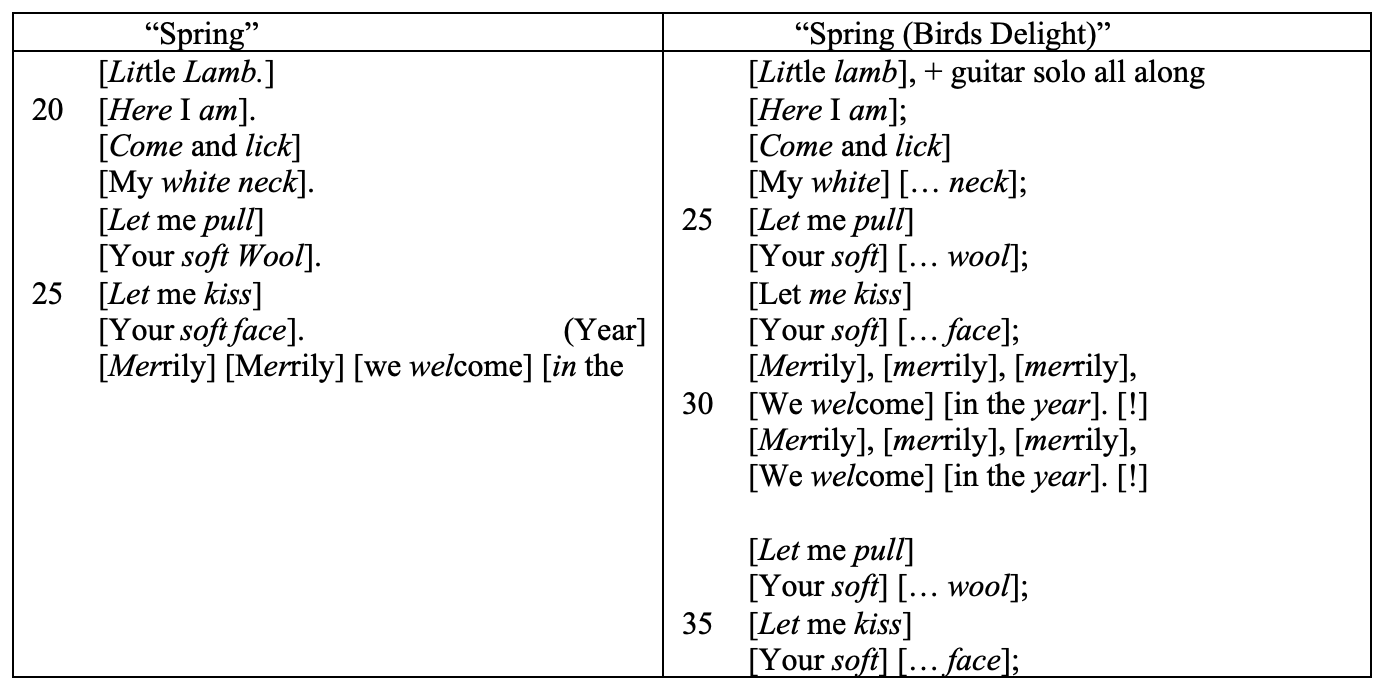 The presence of two different choruses is not surprising, considering that the other songs contain an inner chorus and a meta chorus.
44The reason for the various ways of treating Blake’s stanzas seems clear. Kalugin already had three different musical ideas, with various numbers of bars, and thus three ways of singing, which is typical of his progressive pieces: in “Echoing Green,” the three stanzas, including “Your Grace,” were all sung differently. When there are not enough bars, the stanza has to be shortened, as with the second, and when there are too many, the stanza has to be expanded, as with the third. The incongruous scat (wordless singing, often associated with Louis Armstrong), towards the end of the first stanza and throughout the second, also suggests that this was mixed with the music before the singing of the poem.
45The first stanza is sung by Kalugin – with Olha Rostovska’s high-pitched voice in the background – in a playful manner, alternating, in each rhyming couplet, a rising intonation with a falling one (here shown by the main stress in bold), which echoes the repetitively rising and falling keyboard notes. This fits the nursery rhyme and somehow recalls the playfulness in “The Ecchoing Green” and the singing of the “Old John” stanza. The commas substituted for the full stops do not impact the singing, since the rhyming couplets are well delineated. However, the dash dividing “Lark in sky” (7) and “Merrily” (8) induces a short rest that gives the impression that the singer holds his breath or that the third (eye-)rhyming couplet is incomplete, which is actually the case, since the adverb is integrated into the chorus (9). The scat that starts with the iteration of the second half adds some playfulness, but it is still incongruous and only less so than the exotic chant in “Sunrise.” Likewise, the added echoes to “delight” (3) and “nightingale” (5) would have been more appropriate for “dale” and “sky” (and “Echoing Green” in the previous song), but Kalugin probably used them to emphasise his bird theme.
46In the second stanza, Kalugin’s voice, which is doubled and heard over the scat, is, like the keyboard notes, faster and more urgent. It expresses excitement, encouragement, since there is a possible address to the children (“So do you”), or sounds like a celebration of their joy and “grace.” Once again, neither the semicolons nor the full stops constrain the singing, since the first two rhyming couplets are sung in a row, but this grouping is consistent with the anaphora “Little Boy” and “Little Girl.” The next two lines, “Cock does crow, / So do you,” are sung more slowly but are more heavily punctuated, which is reinforced by the correct pronunciation, [ǝʊ] and [ju:], despite the eye-rhyme. The remaining lines are sung in a row, too, despite the semicolon, but the grouping is again consistent with the repetitions of “merr(ily).” Indeed, the absence of the second half, “To welcome in the year,” revalues the idea of happiness, Kalugin also stressing the last syllable of the third “merrily.”
47The third stanza is sung much more slowly and follows the melody of the electric guitar, so that the singing again seems to have been pasted onto what was perhaps originally planned as the main guitar solo. As the latter is less epic than trippy, it works, though. The singing also follows the units formed by the rhyming couplets more closely, although their run-on lines are ignored, since there is the same rest between “Little lamb” and “Here I am” as between “Let me kiss” and “Your soft face,” for instance. There is a short rest, too, before the last word in lines 22, 25 and 27, which emphasises it and adds some delicacy to the interaction between the child and lamb. This time, the tone is more similar to the first stanza of “Echoing Green”: Kalugin seems now to impersonate the child’s soft voice asking the lamb to kiss their “white neck.” The chorus is, however, slightly lower-pitched than in the first stanza and is sung in full twice, with “we” replacing “to,” as in the poem. As a result of those variations, the difference between the three stanzas is more marked in the song than in the poem.
48The short, repetitive, nursery-rhyme style of the poem aims at rendering the limited language of a child, like the absence of an article before “Nightingale” and “Lark in Sky,” which turns the nouns into names or notions, unless the child speaks directly to the birds. However, “Little Boy” (10), “Little Girl” (12), “So do you” (15) and “Infant noise” (17) rather suggest an adult’s speech, unless the child should speak in the third person, as they sometimes do, before using the first-person pronoun in the last stanza, down to the last chorus (27). Like Old John in “The Ecchoing Green,” perhaps the adult and childlike voices here are one and the same, and the adult changes into the child they used to be, hence the substitution of “we” for “to” in the last line. That there is no return, in the last stanza, to adult “care,” everyday reality and “experience,” at least on the surface, may also explain why Kalugin does not suppress it this time, besides the more obvious reason of space; indeed, there is so much of it that he repeats the last two stanzas. Even though his singing is above all influenced by the pre-existing music, Kalugin seems to have attempted to cope with those potentially different voices, by singing the stanzas differently: the more urgent voice in stanza two thus suggests an adult’s voice, whereas the playful nursery-rhyme-like singing in the first and the softer voice in the last evoke more that of a child.
49The repetitive keyboard notes, which also evoke a nursery rhyme, are accompanied by spaced tom drumming and repetitive stifled guitar chords, as in the introduction to a song before the music is suddenly released. Here, however, the drumming and guitar chords are maintained throughout the song, forming its backbone. Before the singing starts, the very same violin as the frail one closing the previous instrumental, “Tears from the eyelids start (part 2),” reintroduces the theme of innocence and shows that, despite the absence of the meta chorus, “Spring” is definitely connected with the other parts.
50The masculine scat is suddenly counterbalanced by the very high-pitched female voice of Olha Rostovska, who repeats the first half of the second stanza, “Little boy, / Full of joy [,] / Little girl, / Sweet and small [!],” also sung in a row, before Kalugin, supported by Sobolev in the background, takes over for the second half. This allows us to hear both a “little girl” and a “little boy,” but only vaguely, since, as seen above, Kalugin’s singing of the second stanza rather evokes an adult, while Rostovska’s exceedingly high-pitched voice is more playful than child-like. The two voices also suggest the dialogue implied by “So do you,” except that in Blake’s poem, the “adult” seems to be speaking throughout the second stanza. Its second half, really, is a collage of Kalugin’s previous performance, with the same “Merrily, Merrily, Merrily” chorus followed by the same third stanza sung on the guitar solo, a repetition that again marks the “Little Lamb” stanza as another chorus. The only differences are the percussions, which continue, whereas the scat has ceased with the pasting, and the omission of Blake’s chorus. Again, the repetition of the last two stanzas devalues the birds in the first, as the lamb and children seem more important here.
Conclusion
51The statement that the “symphonic art rock suite” is an offshoot of Blake’s poetry, since it is supposed to be “based” on it, is exaggerated. It might be more correct to say that Kalugin’s Romantic feelings and ideas grew independently from the poet’s influence and then merged with his poetry, when the composer found in it echoes of what he felt deep down inside. Thus, because the music appears, at least for the most part, to have been composed before the choice of Blake’s poems, the adaptation is not without shortcomings: the flute is absent when it is mentioned; the exotic scat is incongruous in the context of Blake’s poetry; the distant radio-like voice in “Eternity” and the presence of that poem in the context of the Songs of Innocence are also surprising; the choice of a subtitle for “Spring” is not really relevant; some lines are squeezed into one bar; and the vocal impersonations of Blake’s characters are not always convincing. Even so, the result is homogeneous and harmonious, as Kalugin manages to combine the poetry of Longfellow, himself a Romantic offshoot, with Blake’s, through the common topoï of birds and sunrise, from “Daybreak,” through “Eternity’s Sunrise,” to “The sun does arise” in “Echoing Green.” Although the texts are “only” sung, the new context of associating two different poets within a concept album already rewrites them, for instance, by revaluing birds as symbols of innocence. Besides, Kalugin has composed a light-hearted, even optimistic music that conveys the playfulness and wonder of Romantic innocence. The samples of birds’ songs root his work in nature, and the use of the flute and bassoon gives a pastoral feel to his music; his synthesisers and the either epic or trippy guitar solos open the doors of the imagination, and now that he has become a father, there is a new dimension to the innocence of his child – one of the Romantic trinity, with the rustic and the outcast, be they an idiot or a rebel. For all these reasons, Blake’s Songs of Innocence is a natural choice, although there is also a great difference in Kalugin’s approach to innocence. Even if it was also due to the lack of space, the omission of the last stanza of “The Ecchoing Green” is another instance of his refusal to come back from the land of innocence: like Old John, he prefers to “laugh away care,” and if the album starts in Longfellow’s “Black shadows” (“Birds of Passage,” l. 1), it ends in “Sunrise.” The more disenchanted subtexts of Blake’s illustrations, which do not appear to have inspired Kalugin nor the illustrator of the booklet, a fall from innocence to experience, are thus absent in his adaptation, even though the musical variations and counterpoints in a “symphonic art rock suite” inevitably include gloomier or tenser passages. This is perhaps the main difference with the Romantics: Shelley idealised reality, but was politically involved; Keats indulged in Greek myths and fairy tales, but was wary of “faulture” or the gap between such mythological escapism and an artist’s social responsibilities35; and Blake could not help being concerned by experience, even when he dealt with innocence. On the contrary, over the 2019-2023 period, Kalugin seems to have found in Romantic innocence, nature and imagination a stronghold which he was reluctant to leave, especially in times of war and horror.
1 Van Morrison, A Sense of Wonder, Mercury, 1984. See also his “Influenced by Blake” page on the Van Morrison Official Website, https://www.vanmorrison.com/news/2015/influenced-by-blake (accessed 12 June 2025).
2 Ulver, Themes from William Blake’s The Marriage of Heaven and Hell, Jester Records, 1998.
3 William Wordsworth and Samuel Taylor Coleridge, Lyrical Ballads and Related Writings, ed. by William Richey and Daniel Robinson, Boston, New York, Houghton Mifflin Company, 2002, p. 393.
4 William Blake, Nebuchadnezzar, colour print, ink and watercolour on paper, London, Tate Gallery, 1795-c. 1805.
5 Atomic Rooster, Death Walks Behind You, B&C, Elektra, 1970.
6 The Lieder Net Archive, “Subgroups: Songs of Experience; Songs of Innocence” https://www.lieder.net/lieder/show_poems_in_group.html?CID=470v (accessed 12 June 2025).
7 Antony Kalugin, bandcamp, https://antonykalugin.bandcamp.com/ (accessed 12 June 2025).
8 Karfagen, Birds of Passage, Caerllysi Music, 2020.
9 Gérard Genette, Palimpsests, Literature in the Second Degree [1982], trans. by Channa Newman and Claude Doubinsky, Lincoln, University of Nebraska Press, 1997, p. 46.
10 Karfagen, Passage to the Forest of Mysterious and Birds, Caerllysi Music, 2023.
11 Karfagen, Echoes from within Dragon Island, Caerllysi Music, 2019.
12 In the “Birds (short [instrumental] introduction)” video only available on the bandcamp version of the album; Jah Wobble, The Inspiration of William Blake, Warner Chappell Music Ltd, 1996.
13 Chuck Klosterman, Fargo Rock City: A Heavy Metal Odyssey in Rural Nörth Daköta, New York, Scribner, 2003, p. 139.
14 Karfagen, Land of Green, “Bonus Disk” to Land of Green and Gold, Caerllysi Music, 2022.
15 Henry Wadsworth Longfellow, “The Day is Done,” p. 17, in The Complete Poetical Works of Henry Wadsworth Longfellow, Boston and New York, Houghton, Mifflin and Company, 1893, p. 65.
16 Gérard Genette, 1997, op. cit., p. 16.
17 Ibid., p. 343-344.
18 William Blake, “Eternity,” 1-4, Notebook Poems and Fragments, c. 1789-93, in The Complete Poems, ed. by Alicia Ostriker, London, Penguin, 1977, p. 153 (without punctuation).
19 Also omitted in certain editions, like William Blake, Blake’s Poetry and Designs, ed. by Mary Lynn Johnson and John E. Grant, New York, London, Norton & Company, 1979, p. 183 (without punctuation).
20 https://www.poetryloverspage.com/poets/blake/eternity.html (accessed 25 February 2026).
21 William Blake 1977, op. cit., p. 890.
22 Ibid., p. 509.
23 Henry Wadsworth Longfellow, “Birds of Passage,” 26, 31-32, in The Complete Poetical Works, op. cit., p. 185.
24 William Blake, Songs of Innocence and of Experience [1894], Illustrated Throughout in Full Colour, ed. by Geoffrey Keynes, Oxford, Oxford University Press, 1967, plate 7.
25 https://www.poetryloverspage.com/poets/blake/echoing_green.html (accessed 25 February 2026).
26 Pink Floyd, The Division Bell, Emi, 1994.
27 Joan Baez, Diamonds & Rust, A&M, 1975.
28 Blake 1967, op. cit., p. 133-134.
29 Longfellow, “Birds of Passage,” 6, 2, op. cit., p. 184.
30 Lewis Carroll, Alice’s Adventures in Wonderland and Through the Looking-Glass, with Forty-Two Illustrations by John Tenniel, London, Macmillan, 1902, p. 84.
31 The Holy Bible or The Authorised King James Bible, 1611, at https://archive.org/details/1611TheAuthorizedKingJamesBible/page/n1/mode/2up?q=cockatrice, (accessed 3 July 2025).
32 In William Blake 1967, op. cit., p. 134.
33 https://www.poetryloverspage.com/poets/blake/spring.html (accessed 26 February 2026).
34 Not at all in the bandcamp lyrics, which only add the song’s last two stanzas to the hypotext.
35 Jennifer Wallace, Shelley and Greece, Rethinking Romantic Hellenism, London, MacMillan Press, 1997, p. 87, 94.

Ce(tte) œuvre est mise à disposition selon les termes de la Licence Creative Commons Attribution - Pas dUtilisation Commerciale - Partage dans les Mêmes Conditions 4.0 International. Polygraphiques - Collection numérique de l'ERIAC EA 4705
URL : https://publis-shs.univ-rouen.fr/eriac/1130.html.
Quelques mots à propos de : Fabien Desset
Fabien Desset is a lecturer at the University of Limoges (EHIC), where he teaches British literature, especially Romanticism and the Gothic, as well as courses on rock. He is currently working on Romantic Hellenism, mythopoeism, intertextuality, art, travel, ekphrasis, transmediality, ecosophy and vegetarianism in Romantic and Gothic literature, especially Shelleys’ poetry and prose. He has published several articles in English and French, including “Henry Fuseli’s Nightmare(s) in Mary Shelley’s Frankenstein (1818)” (2021), “Transtextual Transformations of Prometheus Bound in Percy Bysshe Shelley’s Prometheus Unbound: Prometheus’ Gifts to Humankind” (2017), “‘Rime of the Ancient Mariner’”: Iron Maiden’s Adaptation of S. T. Coleridge’s Epic Ballad” (2026), and “The Shelleys’ Tried Bodies in their Travel Literature” (2021). He has also edited a collection of articles in Transparence romantique (Limoges, PULIM, 2014).