Sommaire
7 | 2026
Romantic Offshoots: Reassessing the Legacy of British Romanticism
The aim of this volume is twofold: first, to open up a space for the reassessment of artworks which hark back to, riff on, pay homage to, or uproot their Romantic precursors, while also teasing out some of the more oblique correspondences or affinities between British Romanticism and its descendent forms; and, second, to reexamine the notion of literary inheritance itself, as it pertains to such works – particularly the ways in which many twentieth- and twenty-first-century works willfully enter into an ambiguous relationship with the Romantic tradition. This special issue is itself an offshoot of a research collaboration between ERIAC (Université de Rouen Normandie) and ERIBIA (Université de Caen Normandie). The articles gathered here address the ways in which Romantic-period ideas or models have been reanimated in the light of contemporary concerns, in still-evolving genres (such as sci-fi and dystopian climate fiction, neo-historical biopics, or pop and rock music) and across different media (including graphic novels, television series, and video games), as well as in more traditional forms.

- Jeremy Elprin et Oriane Monthéard Introduction to Romantic Offshoots: Reassessing the Legacy of British Romanticism
- Nathalie Cochoy « Darkling I listen » : l’art du renoncement dans The Great Gatsby et Tender Is the Night, de F. Scott Fitzgerald
- Jeremy Elprin On Not Giving Up the Ghost; or, the Ambivalent Post of Keats’s Letters in Contemporary Fiction
- Caroline Dauphin A Genealogy of the Polypus, from William Blake to H.P. Lovecraft: The Root of All Evil?
- Janneke van der Leest Romantic Mourning for Young Deceased Rock Artists
- Fabien Desset William Blake, Karfagen and Romantic Innocence
- Cal Sutherland “Take me to the Lakes”: Romantic Retreats in Lyrical Ballads and the Lyrics of Taylor Swift
- Armelle Parey Romanticising Women Writers in Biopics: Mary Shelley (2017) and Emily (2022)
- Camille Adnot Mycological Fears: Fungi and Ecological Anxiety from Linnaeus to The Last of Us
- Aurélie Thiria-Meulemans Planting the Seeds of Post-Apocalyptic Fiction: The Legacy of Byron’s “Darkness” and Cain, A Mystery
7 | 2026
Mycological Fears: Fungi and Ecological Anxiety from Linnaeus to The Last of Us
Camille Adnot
Cet article analyse la vision persistante des champignons comme êtres monstrueux et taxinomiquement instables, en retraçant ses origines dans les débats botaniques du xviiie siècle et en examinant son héritage dans la littérature romantique et la fiction environnementale contemporaine. À la fin du xviiie siècle, les champignons occupent une position incertaine dans les systèmes de classification. Quoique traditionnellement classés parmi les plantes, leur statut ambigu entre règnes végétal et animal est souligné par Linné et Erasmus Darwin. Leur reproduction cryptogamique, leur croissance rapide et leur association à la décomposition nourrissent des inquiétudes liées à l’hybridité, à la monstruosité et à la porosité des frontières biologiques. En m’appuyant sur les travaux de Theresa Kelley et Susannah Gibson, je montre comment ces incertitudes sont amplifiées par l’imaginaire romantique. Chez Erasmus Darwin, William Blake et Percy Shelley, les champignons deviennent des acteurs de transformation d’un règne à l’autre, de maladie et de dissolution de l’identité humaine. La poésie romantique mobilise ainsi l’instabilité taxinomique pour interroger la pastorale et explorer les limites de l’humain. L’article se tourne ensuite vers le jeu vidéo et la série télévisée contemporains The Last of Us, où une mutation du cordyceps engendre des hybrides fongiques. J’avance que la représentation de cette contagion, dans ces deux formes narratives, prolonge les inquiétudes romantiques liées à l’hybridation. En m’appuyant sur la notion de post-pastorale de Terry Gifford, je suggère que l’œuvre met en scène une catastrophe écologique pour repenser l’humanité au sein d’un écosystème dynamique et interconnecté. La reconfiguration romantique des taxinomies et de la pastorale éclaire ainsi les imaginaires contemporains du posthumain.
This article explores the enduring perception of fungi as monstrous and taxonomically unstable, tracing its roots to eighteenth-century botanical debates and examining its legacy in Romantic writing and contemporary environmental fiction. In the late eighteenth century, fungi held an uncertain position within natural classification systems. While traditionally grouped among plants, figures such as Linnaeus and Erasmus Darwin exposed their ambiguous status between vegetal and animal realms. Their cryptogamic reproduction, rapid growth, and association with decay fostered anxieties about hybridity, monstrosity, and porous biological boundaries. Building on the work of Theresa Kelley and Susannah Gibson, I examine how these scientific uncertainties were amplified through the Romantic poetic imagination. In texts by Erasmus Darwin, William Blake, and Percy Shelley, fungi become agents of cross-kingdom transformation, disease, and the dissolution of human identity. Romantic poetry thus draws on taxonomic instability to interrogate pastoral conventions and explore the limits of the human. The article then assesses the legacy of that perception, turning to the contemporary video game and TV series The Last of Us, in which a mutated strain of cordyceps transforms humans into fungal hybrids. I argue that in both media, the representation of fungal contagion inherits Romantic anxieties about hybridisation. Drawing on Terry Gifford’s concept of the post-pastoral, I suggest that the series stages ecological catastrophe in order to reimagine humanity as embedded within a dynamic, interconnected ecosystem. The Romantic reconfiguration of taxonomy and the pastoral thus continues to shape contemporary visions of the posthuman.
1What biological kingdom do fungi belong to? Are they plants, animals, or something else entirely? And why are they often associated with monstrosity? This article does not aim to offer thorough biological answers, but it examines the enduring perception of fungi as monstrous and indefinable, tracing this idea back to the eighteenth century – and more specifically, the Romantic era. By emphasising the crucial contribution of Romantic-era biologists and writers in shaping fungi as hybrid, cross-kingdom organisms, it explores the persisting legacy of Romantic natural classification in environmental fiction.
2The eighteenth century marked a turning point in the classification of fungi. While they had been categorised as plants since Antiquity, this period saw the rise of a debate among botanists regarding their placement within the natural hierarchy – somewhere in between the vegetal and animal realms delineated by Aristotelian taxonomy. While Linnaeus classified fungi as vegetal organisms, Erasmus Darwin stressed their ambiguity, comparing them to animals. The botanist James Sowerby, who published Coloured Figures of English Fungi or Mushrooms (1789-1791), crystallised such uncertainties by linking fungi to monstrosity. The biological hybridity and cryptogamic nature of fungi blurred boundaries with other organisms, opening speculation about the scope of their influence. In my approach, I draw on the scholarship of Theresa Kelley in Clandestine Marriage: Botany and Romantic Culture (2012)1 and Susannah Gibson in Animal, Vegetable, Mineral? How Eighteenth-Century Science Disrupted the Natural Order (2015),2 in exploring hybridity between natural realms. I examine how the scientific debate on fungi was extended through the poetic imagination, focusing on the works of Erasmus Darwin (The Loves of the Plants, 1791),3 William Blake (Milton, c. 1804-1811 and Jerusalem, c. 1804-1820),4 and Percy Shelley (The Sensitive-Plant, 1820),5 to highlight how the Romantic poetic imagination seized this debate. Additionally, I examine how fungi were linked to disease in the works of Blake and Shelley, referencing similar ideas that take on a political angle in the works of Robert Southey and James Gillray.
3In assessing the enduring influence of the Romantic imagination on fungi, I focus on the contemporary video game and TV series The Last of Us. Set in a post-apocalyptic world, The Last of Us creates a scenario in which a mutated strain of cordyceps – a parasitic fungus – triggers a global pandemic, turning humans into zombie-like organisms. Interestingly, zombies are creatures which are traditionally regarded as neither dead nor alive, or “living dead,” a quality also associated with fungi. The video game’s first and second instalments developed by Naughty Dog (2013, 2020, dir. Bruce Straley and Neil Druckmann) were appraised for their intricate world-building and cinematic quality. The HBO show adaptation (2023-, dir. Craig Mazin and Neil Druckmann) was equally praised for its inventive visuals and biological realism. In the wake of the covid pandemic, many have noted the relevance, and quasi-prophetic nature of the narrative, reactivating age-old anxieties about the natural world and parasites that might slip into the human realm. This anxiety aligns with a deeper questioning of the boundaries between the human and the nonhuman – or even posthuman – that was particularly active in the Romantic era.
4The recent efforts on the part of ecocriticism to decentre our gaze from the human, and to acknowledge its connectedness with the nonhuman, provide a useful prism through which to approach the video game and series. The blurring of fungi and humans in The Last of Us prompts an analysis through the lens of the post-pastoral mode, defined by Terry Gifford in Pastoral (1999) as a paradigm wherein the boundaries between the human and natural realms blur. Gifford argues for the recognition that “our inner human nature can be understood in relation to external nature,” and defines post-pastoral narratives as ones which convey “an awareness of both nature as culture and of culture as nature.”6 Because of the Romantic era’s central role in environmental humanities scholarship, Romanticism offers fertile ground for theorising the post-pastoral. Thus, this article assesses the legacy of the Romantics’ challenges to taxonomy and the pastoral in contemporary environmental fiction, with a particular focus on fungi.
5I first go back to taxonomical debates in the eighteenth century, emphasising the unstable definition of fungi. I then examine their evolution in the Romantic poetic imagination and beyond. Lastly, I focus on the persistence of Romantic fears of hybridisation linked to fungi in the video game and TV series The Last of Us.
Eighteenth-century Taxonomical Debates
6The modern system of organism classification emerged with Linnaeus in the eighteenth century, especially in Systema Naturae (1735). While Linnaeus was not groundbreaking in his classification of fungi, retaining their traditional placement among plants, he introduced a shift in Genera Plantarum (1737). Indeed, he divided plants into twenty-four classes, naming the twenty-fourth “Cryptogamia,” for plants with hidden reproductive structures – plants that lacked flowers and seeds, such as fungi. In Clandestine Marriage: Botany and Romantic Culture (2012), Theresa Kelley highlights the problems posed by Linnaeus’s introduction of this category:
The plants he [Linnaeus] lumped together in the twenty-fourth and last class, which he named Cryptogamia – literally, “clandestine marriages” – were those whose reproductive organs and functionality he could not identify. The mysteriousness of the Cryptogamia (Linnaeus included ferns, mushrooms, lichens, and algae in this class) and their status as outliers in the sexual system of plants prompted even more interest after his death, as botanists, amateur and thoroughly professionalized, kept returning to these plants, some of which offered evidence that eventually prompted the decision to abandon the Linnaean systematic for some version of what came to be called the Natural System.7
7As Kelley explains, after the death of Linnaeus in 1778, research into cryptogamia developed. Many botanists engaged with these questions, including William Curtis (Flora Londinensis, 1777-98 and Beauties of Flora, 1820), James Sowerby (English Botany, 1790-1814), J. E. Smith (Flora Britannica, 1800, and a contributor to English Botany), and John Lindley (Ladies’ Botany, 1834-37). In addition to these extensive studies, debates unfolded in horticultural magazines such as the Botanical Magazine (1787-) and the Botanical Register (1815-1847), as well as in more general periodicals such as The Gentleman’s Magazine (1731-1922) and The Monthly Review (1749-1845). This surge in botanical discourse heightened awareness of the difficulty of adhering to a single natural system, underlining the shifting, elusive character of many plants – especially fungi. Kelley comments on this multiplication:
As it developed from the late eighteenth century into the early nineteenth, the Natural System consolidated powerful shifts and as many irresolutions in botanical culture. As a taxonomic approach that was no longer willing to pursue single characters […] the natural system elaborated a paradox: to identify communities of plants (or quasi plants, as lichens and fungi were increasingly suspected to be), taxonomists had both to recognize a plurality of differentiating functions and parts and insist on their common cellular basis.8
8As emphasised by Kelley’s remarks, such botanical “irresolutions” were not limited to fungi. However, because of their mysterious and ambiguous character, fungi came to epitomise that irresolution.
9Among English botanists interested in fungi, the most prominent was James Sowerby. The latter had contributed to The Botanical Magazine, first published in 1787. In 1790, Sowerby began publishing English Botany, an ambitious, 36-volume opus whose publication went until 1814. Moreover, his Coloured Figures of English Fungi or Mushrooms appeared in four volumes between 1789 and 1791, and was lavishly illustrated, marking it as the most ambitious opus on fungi of the late eighteenth century. The illustrations detail multiple kinds of fungi, often showing their growth on other organisms (Fig. 1).
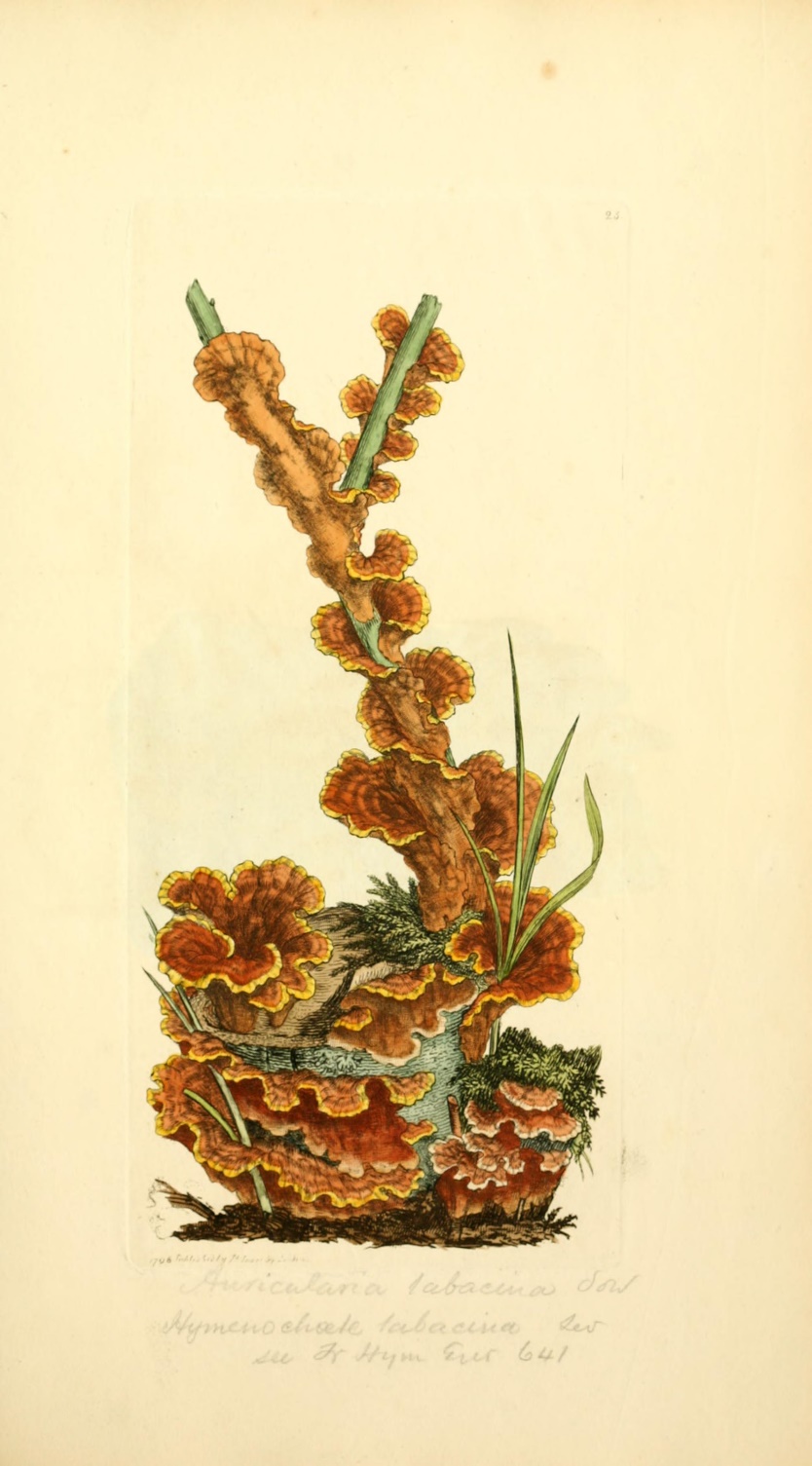
Fig. 1 : James Sowerby, Coloured Figures of English Fungi or Mushrooms [1789-1791], Vol. 1, Tab. XCIV. London, Printed by J. Davis, 1797. Hand-coloured engraved plate. Size unknown. New York Botanical Garden, LuEsther T. Mertz Library. Digital collections accessed via Biodiversity Heritage Library. Creative Commons. https://www.biodiversitylibrary.org/page/5750765
10Several illustrations highlight the saprophytic nature of fungi, portraying them growing on decaying organisms, such as dead leaves (Fig. 2).
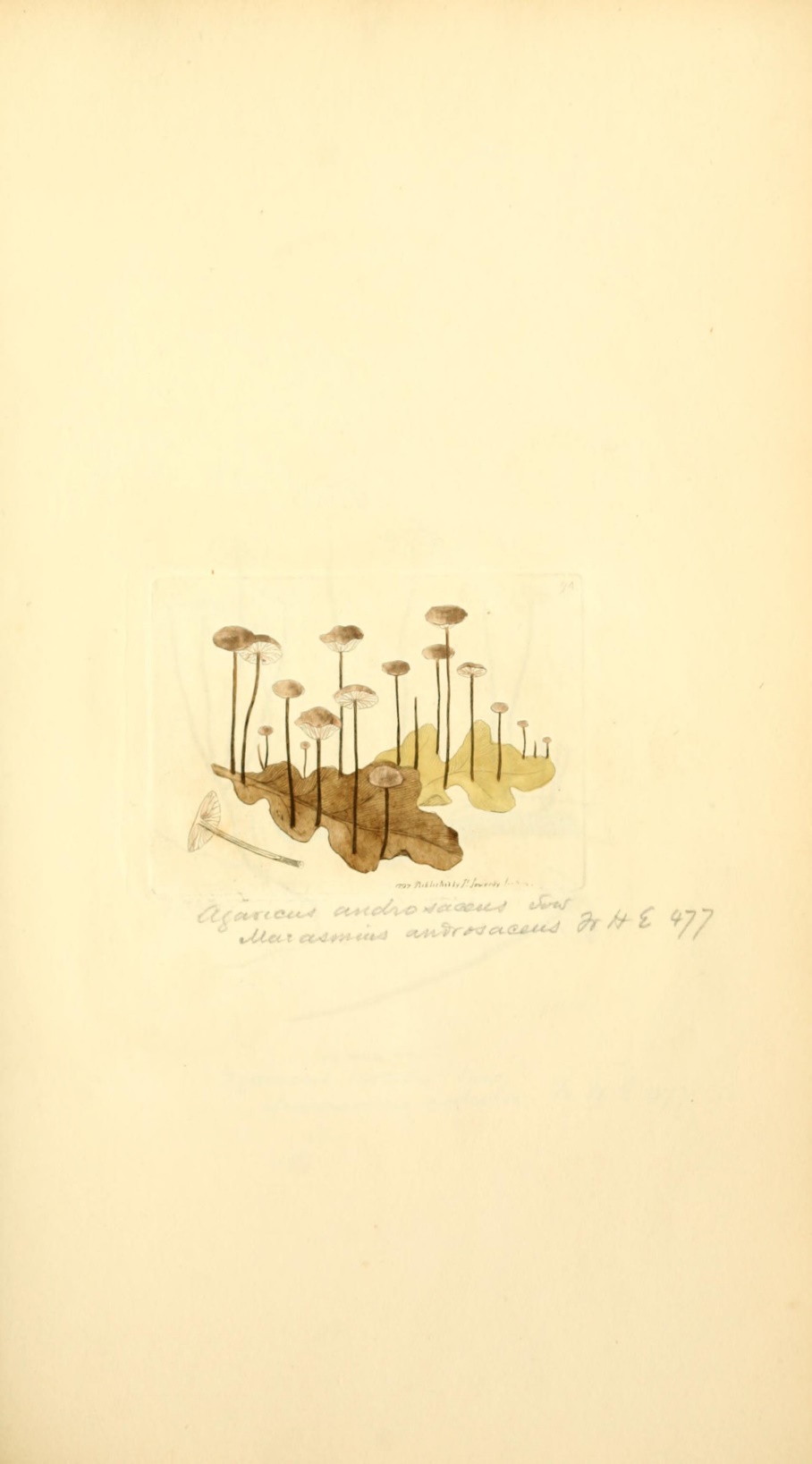
Fig. 2: James Sowerby, Coloured Figures of English Fungi or Mushrooms [1789-1791], Vol. 1, Tab. XCIV. London, Printed by J. Davis, 1797. Hand-coloured engraved plate. Size unknown. New York Botanical Garden, LuEsther T. Mertz Library. Digital collections accessed via Biodiversity Heritage Library. Creative Commons. https://www.biodiversitylibrary.org/page/5750713
11Among Sowerby’s manuscript papers on fungi, there is a note on “monstrosity,” a term which, Kelley observes, “often turns up when contemporary writers discuss cryptogamics, including fungi.”9 The note, transcribed by Kelley,10 reads thus:
Accuracy is ever to be admired yet in some instances it may be wrong applyed Thus were I to endeavour to arrange the creation begining with any individual for instance Man, I might light of one with all the parts belong to a most perfect man. Consequently I might make a good and perfect Description–pursuing my theme I might go on acurately describing every creature I met with, and might light of beings like the man I had described with every part somewhat longer & shorter[?] or[?] broader [something crossed out] or with some extraordinary protuberance or monstrosity a limb less &c consequently an acurate description would make a new being or species and a monstrosity or lusus natura might be made a species when it was only a meer variety.11
12Though somewhat muddled, Sowerby’s note reveals his awareness of the limitations of classification. He advocates for a more inclusive approach to account for “extraordinary” variants. Kelley offers enlightening remarks on this note, comparing it to Frankenstein’s making of his creature in Mary Shelley’s novel:
Imagining a situation with an uncanny resemblance to Victor Frankenstein’s botched creation of a creature that was to have been beautiful but turned out to have “every part somewhat longer & shorter,” Sowerby considers how a taxonomic definition of a man might well go wrong, mistaking perfection for monstrosity, or a new species for a variety. Much is left open for inquiry here: the possibility of taxonomic error, the question of how one goes about defining the human species – a question widely asked throughout the era –and the possibility that one taxonomist’s monstrosity might be either a new species […] or simply a variety.12
13Kelley’s comments draw attention to the problematic definition of monstrosity. Indeed, monstrosity appears to be merely a species not yet encountered or identified, or a variation of one previously thought to be known. Rather than a scientific term, monstrosity serves as a marker of the limits of knowledge, hinting at what remains unclassified. Likewise, in Animal, Vegetable, Mineral? How Eighteenth-Century Science Disrupted the Natural Order (2015), Susannah Gibson notes the decreasing relevance of limiting classifying constraints at the turn of the century. She argues that the emergence of new sciences changed the criteria for telling species apart:
By the end of the eighteenth century, the ancient ideas about what it meant to say that something was an animal, a vegetable, or a mineral were becoming obsolete. New theories that defined animals by their mechanics or their chemistry were being taken more seriously. This changing view of nature developed even further in the nineteenth century as the new disciplines of cell theory, physiology, embryology, biochemistry, microbiology, and evolutionary science matured.13
14As new sciences emerged, new tools appeared for distinguishing patterns of similarity and difference between species. Such reflections inspired the poetic imagination, which positioned itself in this debate – very much like an offshoot, or a literary manifestation of the “extraordinary protuberance or monstrosity” Sowerby writes of.
Fungi in the Romantic Poetic Imagination and Beyond
15Reflections on the human body and its openness to intermingling with other species is not the invention of the Romantics. Classical mythology is full of stories of transformation, and the enduring popularity of Ovid’s Metamorphoses attests to a sustained fascination with the flexible boundaries between the human, animal, and vegetal realms. The Metamorphoses were popular in England throughout the eighteenth century, with a 1717 edition by Samuel Garth, including translations of prominent literary figures such as Joseph Addison, John Dryden, John Gay, and Alexander Pope. The collection enjoyed many reeditions in the eighteenth century, including one in 1794, during the decade when botanical speculation seized the poetic imagination most perceptibly. What changed in the Romantic period was that crossing from the human to the nonhuman realm was no longer perceived as a possibility offered by myth, but by science.
16The most significant poetic work of the era from a botanical standpoint was Erasmus Darwin’s The Botanic Garden (1791), whose second part, The Loves of the Plants, presents and revises the Linnaean classification system. One of the characters of the poem, Tremella – the personification of jelly fungi – becomes encased in ice as frost overtakes her. The very personification of fungus calls into question the boundaries between fungi and humans. Darwin provides an explanatory note in which he discusses the hybrid properties of fungi. In a note on “Clandestine Marriage–Cryptogamia,” he remarks on the poisonous capacities of fungi: “Some of the Fungusses are so acrid, that a drop of their juice blisters the tongue; others intoxicate those who eat them.”14 He likens them to plants in this respect, observing that boiled mushrooms are less acrid: “As all acrid plants become less so, if exposed to a boiling heat, it is probable the common mushroom may sometimes disagree from being not sufficiently stewed.”15 However, he entertains the possibility of classifying fungi within the animal realm due to their meaty taste, their tendency to putrefy, and their ability to grow without light:
There was a dispute whether the fungusses should be classed in the animal or vegetable department. Their animal taste in cookery, and their animal smell when burnt, together with their tendency to putrefaction, insomuch that the Phallus impudicus has gained the name of stink-horn; and lastly, their growing and continuing healthy without light, […] would seem to shew that they approach towards the animals, or make a kind of isthmus connecting the two mighty kingdoms of animal and of vegetable nature.16
17The idea of an “isthmus” connecting the animal and vegetal realms emphasises the fundamental in-betweenness of fungi: they occupy a liminal space. Theresa Kelley points out that the unstable nature of plants, among which fungi, inspired Erasmus Darwin as well as other Romantic poets, making for creative minglings:
This view of plants as spectral, cross-kingdom travelers was, if anything, a bonus for poetic figure, all the more so because plant names, most apparently common names, often imagined them as cross-kingdom beings […]. Erasmus Darwin made Linnaeus’s marriages the scandalous vehicle for a much wider array of suppositional crossovers between plants, animals, and minerals in The Loves of Plants, part 2 of The Botanic Garden. Here and elsewhere in romantic era writing, being averse to fixed categories worked within but also against the ongoing taxonomic project of finding classificatory homes and arrangements for all plants.17
18As evidenced by Kelley, the complex qualities of certain plants and fungi provided rich inspiration for the poetic imagination, sparking a proliferation of creative hybridisations.
19While the instability of fungi could be celebrated, it also fed anxieties as to their role in nature. In The Sensitive-Plant (1820), a poem in three parts, inspired by Darwin’s The Loves of the Plants, Percy Shelley dramatises the link between fungi and decomposition. The poem describes a beautiful garden tended by a Lady, who dies at the end of the second part, leading the beautiful flowers to die. The garden then starts to putrefy in the third and last part: “The garden once fair became cold and foul / Like the corpse of her who had been its soul.”18 As a result, “monstrous” weeds and fungi take over the garden:
And plants, at whose names the verse feels loath,
Filled the place with a monstrous undergrowth,
Prickly, and pulpous, and blistering, and blue,
Livid, and starred with a lurid dew.
And agarics and fungi, with mildew and mould
Started like mist from the wet ground cold;
Pale, fleshy, – as if the decaying dead
With a spirit of growth had been animated!19
20Fungi are likened to mildew and mould – agaric being a type of mushroom. There is an explicit link between fungi, monstrosity, and putrefaction. The poem veers into horror, dramatizing the “decaying dead” being “animated,” in a process reminiscent of zombification. The saprophytic nature of fungi is invoked to showcase their role as decomposers, placing them at the threshold between the living and the dead. While the poem starts off as pastoral, the pastoral scene is cut short at the death of the Lady, which darkens the tone, causing the poem to decay into an anti-pastoral. Moreover, the Lady’s death parallels that of the garden, establishing a link between human life and nature. This continuum between the human and the nonhuman is identified by Terry Gifford as one of the features of the post-pastoral, leading to the recognition that “what is happening in us is paralleled in external nature.”20 However, the garden in Shelley’s poem does not exactly die; instead, it continues living with a monstrous life. The poem becomes about monstrous growth, simultaneously questioning the limits of human life by exploring nonhuman life, and the limitations of the pastoral, by proposing a post-pastoral. Fungi offer a vehicle for this questioning.
21The monstrous quality of fungi was addressed by other Romantic poets. In The Marriage of Heaven and Hell (1794), William Blake relates his journey with a moralising angel through a cavern which leads to a dark abyss, where the angel in question is “suspended in a fungus which hung with the head downward into the deep.”21 Monstrous spiders soon appear in the deep, joined by the biblical beast Leviathan, establishing a monstrous kinship between them and the mushroom which takes on hellish qualities. Although Blake does not refer to fungi explicitly elsewhere in his writings, his works probe the implications of hybridisation, contemplating the dissolution of the human form into the vegetal and animal realms in subversive anti-pastoral scenes. Blake had contributed to illustrating Darwin’s The Botanic Garden and was inspired by its cross-kingdom imagination.22 He likens the nerves in the human body to the roots of plants, writing of Man’s “vegetated mortal Nerves”23 in Milton a Poem (c. 1804-1811). Building on the similarity between nerves and roots, Blake imagines a humanoid, multi-connected monster of sorts. He thus develops the figure of the Polypus as a collective body and hivemind: “every Man born is joined / Within into One mighty Polypus.”24 In Jerusalem (c. 1804-1820), Blake likens the Polypus more explicitly to plants, pondering on the monstrosity of humans enrooting into the ground:
[…] till the Twelve Sons of Albion
Enrooted into every Nation: a mighty Polypus growing
From Albion over the whole Earth: such is my awful Vision.25
22The Polypus is defined as a human-born, many-rooted weed, which connects in multiple places and plagues “the whole Earth.” The implications are, of course, political, as the “Sons of Albion” act as personifications of English expansionism, but the imagery is botanical. The Polypus echoes fungi insofar as it presents a form of intelligence sustained by underground networks of communication, reminiscent of mycelial structures. In Entangled Life: How Fungi Make our Worlds, Change our Mind & Shape our Futures (2021), Merlin Sheldrake explains the theory of the “wood wide web,” based on the study of fungal-root relations: “[…] many plants can connect with a single fungal network. In this way a variety of substances, from nutrients to signaling compounds, can pass between plants via fungal connections. In simple terms, plants are socially networked by fungi.”26 Although Blake could not have been familiar with this knowledge, he imagines a similar dynamic and grounds his political critique in a vegetal process, which is echoed by the visuals of his illuminated poems. Many designs illustrate this process of enrooting, which is evidently painful, the figures assimilating into the ground displaying expressions of terror and despair (Fig. 3, Fig. 4).
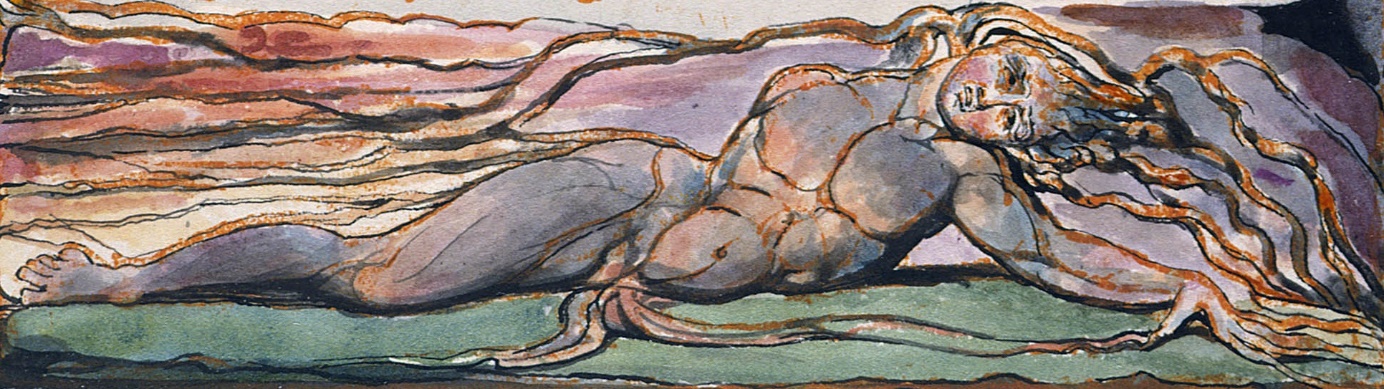
Fig. 3: William Blake, Detail from Jerusalem, the Emanation of the Giant Albion, c. 1804-1820, Copy E (c. 1821), Plate 74 (22.6 x 16.5 cm). Hand-coloured relief and white-line etching, with watercolour and pen and black ink. Yale Center for British Art, Paul Mellon Collection.
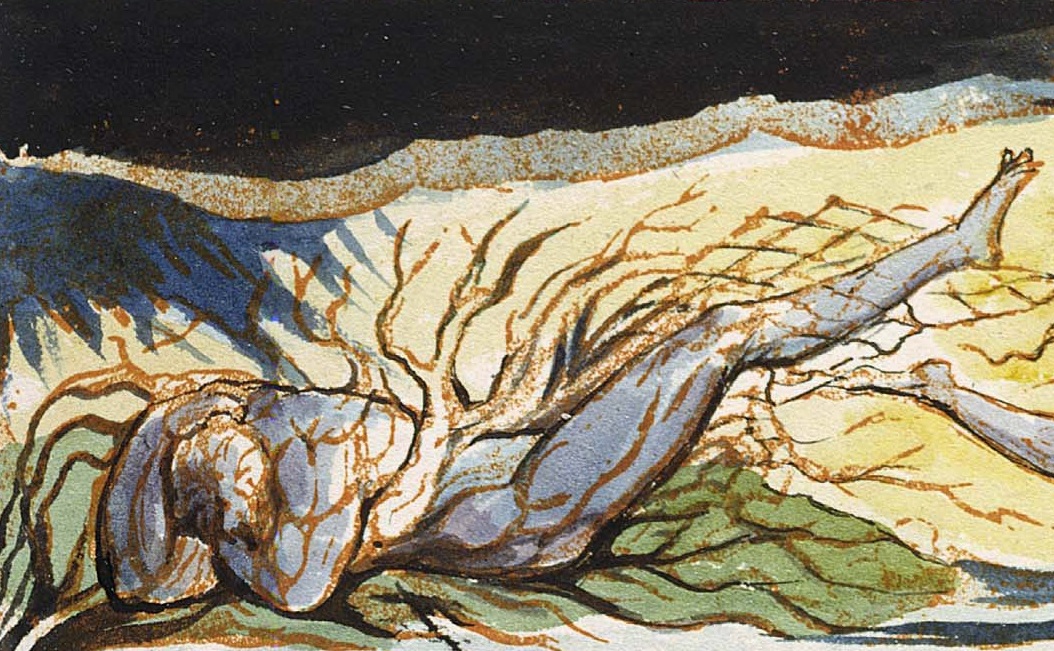
Fig. 4: William Blake, Detail from Jerusalem, the Emanation of the Giant Albion, c. 1804-1820, Copy E (c. 1821), Plate 45 (22.6 x 16.2 cm). Hand-coloured relief and white-line etching, with watercolour and pen and black ink. Yale Center for British Art, Paul Mellon Collection.
23Moreover, the Polypus evokes fear and repulsion insofar as it negates individuality. Its members feed a body which is hidden in an underground network: “By Invisible hatreds adjoind, they seem remote and separate / From each other; and yet are a Mighty Polypus in the Deep!”27 Because of its features, the Polypus may be regarded as a variant on fungi, as its members connect underground and share a consciousness. It also grows without light, like fungi: “a mighty Polypus, vegetating in darkness.”28 The image is that of a hidden parasite working its way towards controlling the hosts it connects to.29
24The uncontrollable growth of fungi caught the imagination of Romantic writers. The subject extends beyond botany – as is already the case with Blake, where the Polypus embodies a critique of the British Empire. In Robert Southey’s political essay presenting an imaginary conversation between himself and Thomas More, Sir Thomas More, or, Colloquies on the Progress and Prospects of Society (1829), Southey discusses the British political system. On the subject of corruption, he likens it to a cyst protruding from the skin, or fungus:
You have prided yourselves upon this system, you have used every means for extending it; you have made it the measure of your national prosperity. It is a wen, a fungous excrescence from the body politic: the growth might have been checked if the consequences had been apprehended in time; but now it has acquired so great a bulk, its nerves have branched so widely, and the vessels of the tumour are so inosculated into some of the principal veins and arteries of the natural system, that to remove it by absorption is impossible, and excision would be fatal.30
25This passage suggests the process of branching out has become unstoppable. Southey describes an intricate network of “veins” and “arteries,” blending animal nerve imagery with plant root imagery. The reference to inosculation, the natural process in which plant branches fuse together, is a striking image of hybridisation. The passage also carries hints of disease, with the mention of a “tumour.” The “fungous excrescence” is presented as the manifestation of an infectious parasite, serving as a metaphor for political corruption. It is worth noting that fungi provided political images for visual artists as well; the satirical cartoonist James Gillray, for instance, depicted political corruption through fungi in his print An Excrescence, a Fungus, alias a Toadstool upon a Dunghill (1791) (Fig. 5).
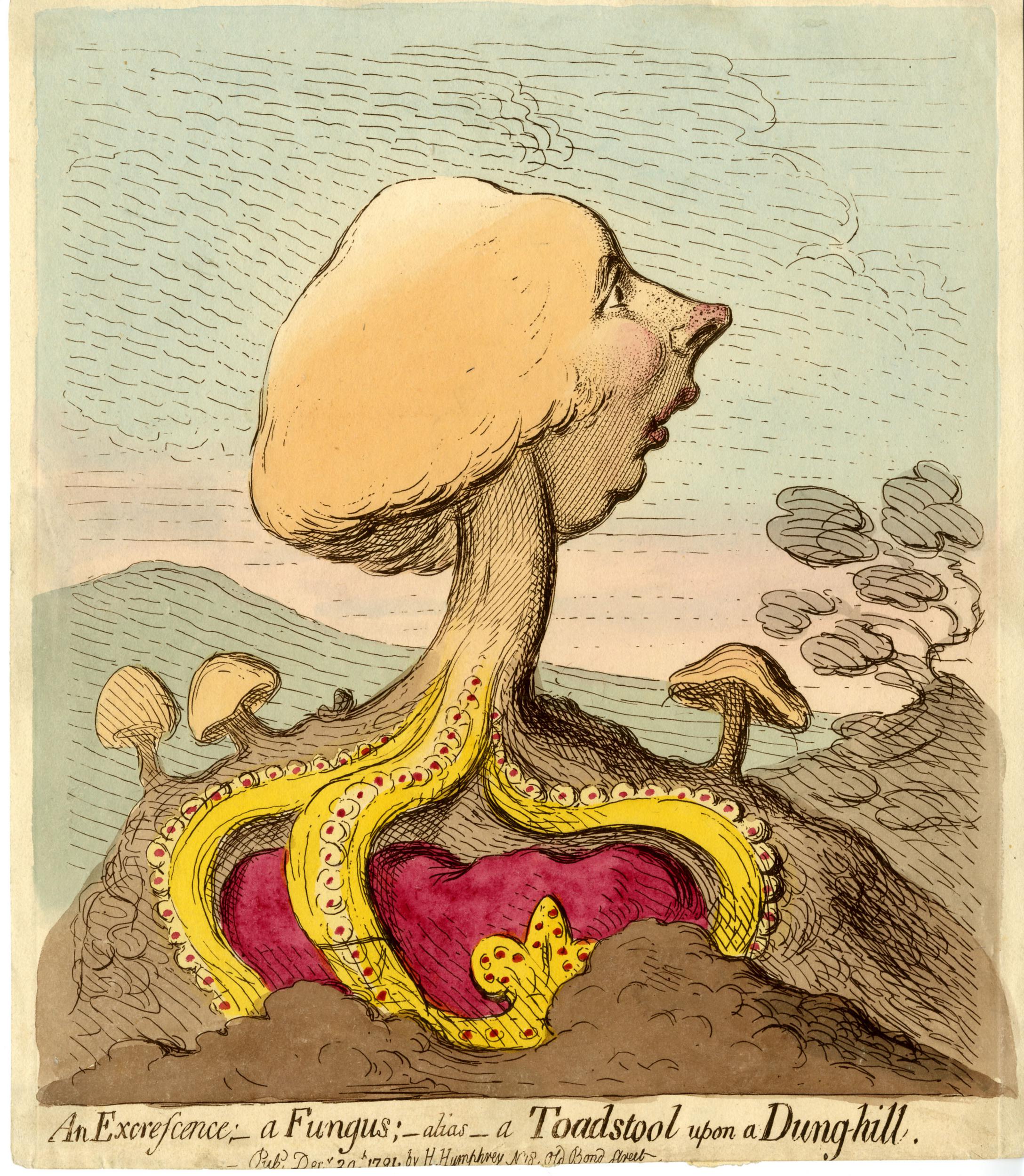
Fig. 5: James Gillray, An Excrescence, a Fungus, alias a Toadstool upon a Dunghill (1791), Hand-coloured etching, 276 x 240mm. © The Trustees of the British Museum. Creative Commons.
26In this satiric cartoon, the then Prime Minister of Great Britain, William Pitt, is portrayed as a fungus, which feeds on and grows out of roots formed by a gold crown underground.
27In the wake of Romantic botanical culture, fungi have continued to fascinate post-Romantic botanists and writers. From the 1820s and 1830s onwards, new scientific discoveries by mycologists led to the reclassification of fungi, which were put in a category of their own. Important scholars of this period include the Swedish Elias Magnus Fries (Systema Mycologicum, 1821-1832), and the American Lewis David von Schweinitz (Synopsis Fungorum Carolinæ Superioris, 1822). In England, the most significant mid-century scholar on fungi was Miles Joseph Berkeley, (Introduction to Cryptogamic Botany, 1857 and Outlines of British Fungology, 1860). These works signalled a greater understanding of the complexities of fungi, and their difference from both the vegetal and animal realms. However, the association of fungi with magic and disease did not recede. One may think of Lewis Carroll’s Alice’s Adventures in Wonderland (1866), where, following the advice of the caterpillar, Alice becomes in turn taller or shorter after eating a magical mushroom. Interestingly, Alice is mistaken for a serpent after eating of the mushroom, hinting at a potential crossover between natural categories. Fungi also retained their association with sickness. In The Time Machine (1895), when H.G. Wells imagines a utopian, future version of Earth free from illness and parasites, his narrator notes that it is devoid of fungi: “The air was free from gnats, the earth from weeds or fungi; everywhere were fruits and sweet and delightful flowers; brilliant butterflies flew hither and thither. The ideal of preventive medicine was attained.”31 The mention of “medicine” suggests that fungi are the source of its opposite, disease, showing anxiety as to the poisonous capacities of fungi. If a world free from fungi represents a utopia, then its opposite, a world overtaken by fungi, is a dystopia.
The Persistent Fear of Hybridisation in The Last of Us
28Despite, or perhaps because of advancements in mycology during the twentieth century leading to the establishment of fungi as a distinct kingdom, mycota, the Romantic fascination with fungi has persisted. There is still much that is unknown about fungi; Sheldrake observes, “We are only just beginning to understand the intricacies and sophistications of fungal lives.”32 Recent research has suggested that their networks communicate across large scales, thereby creating collective consciousness and collective intelligence.33 Such a kind of collective intelligence is explored in the video game and TV series The Last of Us (2013-2020; 2023-).
29In the narrative, cordyceps, a type of fungus, spreads across the world via contaminated crops, transforming the humans who encounter it into floral zombies, which become agents of a rhizomatic, fungal collective consciousness. Their aim is to transform as many people as possible, through biting or releasing spores. The narrative stands out from other popular zombie stories due to its ecological approach. Cordyceps may be approached through Anna Tsing’s notion of “disturbance” in The Mushroom at the End of the World (2015).34 Tsing defines disturbance as “a change in environmental conditions that causes a pronounced change in an ecosystem,” and further argues that it “opens the terrain for transformative encounters, making new landscape assemblages possible.”35 The zombies are the result of an environmental crisis – global warming, as suggested by the opening scene to the TV series – and their gradual evolution proposes a reflection on the human, the nonhuman, and the posthuman. The opening credits to the TV series dramatise how porous the boundaries between these categories are, displaying fluid imagery that alternates between human and nonhuman-looking fungal compositions. Fungi arrange and rearrange themselves in structures evocative of a city (Fig. 6),36 a human skull (Fig. 7),37 and the silhouettes of the two protagonists, Joel and Ellie, rising from the ground like plants (Fig. 8).38 These images vividly display the porosity of the barrier between the human and nonhuman worlds. Such porosity resonates with contemporary scientific research: Tsing highlights our shifting perception of collaborative processes across species, noting that “interspecies entanglements that once seemed the stuff of fables are now materials for serious discussion among biologists and ecologists.”39 Similarly, Sheldrake reflects on parasitic entanglements exemplified by cordyceps. He describes plants, fungi, and animals as “composite beings,” stressing that parasites are integral to our existence: “we all inhabit bodies that we share with a multitude of microbes without which we could not grow, behave, and reproduce as we do.”40 However, Sheldrake notes the limits of parasitism, stating that “mind-manipulating fungi remain some of the most dramatic examples of composite organisms.”41
30One of the striking qualities of The Last of Us is the design of the contaminated humans. The game offers a gradation in the design depending on how long a human has been infected, with fungal characteristics gradually taking over their human likeness. Clickers are the most iconic monsters in the game, corresponding to humans who have been infected for over a year, and displaying the greatest degree of mingling. Not only are they covered in fungal outgrowths, but their skull has cracked open, with fungi blossoming out of their brains (Fig. 9,42 Fig. 1043). As such, they embody the anxiety of hybridisation between humans and mycota. In a video interview with Vanity Fair (2023), Barrie Gower, the prosthetics designer for the HBO show, details the types of mushrooms the creators were inspired from; he dwells on shelf mushroom (Fig. 11)44 and chicken of the woods (Fig. 12).45 Gower emphasises the floral grounding of the visuals for clickers: “Their anatomy and the design of the character has this huge, kind of floral petals, organic shapes, which are breaking out of the cranium.”46 The designers’ work on increasing levels of dehumanisation for the infected reflects their integration of contamination into the world-building. Although the imagery of The Last of Us draws on plants, the merging of humans and fungi is, biologically speaking, less of a leap than a merging of plants and fungi. Sheldrake notes, “Although fungi have long been lumped together with plants, they are actually more closely related to animals,” adding that “[a]t a molecular level, fungi and humans are similar enough to benefit from many of the same biochemical innovations.”47
31Another intriguing feature is that some of the infected, especially those who are dying, tend to sit or stand against a wall and gradually merge with it (Fig. 13).48 Sprouts extend from their bodies, spreading across the wall, allowing fungi to travel, reach other floors, and release spores. Though the infected attached to walls become motionless, they remain aware of their surroundings; vast networks of fungal arteries extend from them, enabling them to sense approaching humans and to communicate with other infected hosts, sending them to attack. Although this hunting feature is anthropomorphic, the infected’s network cleverly draws on the logic of mycelial structures. Sheldrake explains, “A mycelial network has no head and no brain. Fungi, like plants, are decentralized organisms. […] Control is dispersed: Mycelial coordination takes place both everywhere at once and nowhere in particular.”49 In the Romantic imagination, this omnipresence recalls Blake’s “mighty Polypus in the deep,” invisible on the surface, or Southey’s “tumour” branching widely. Sheldrake himself traces the notion of entangled organisms back to Romantic-era naturalist Alexander von Humboldt, underlining the continuities between Romantic science and our own.50 Moreover, the underground network also resonates with the “monstrous undergrowth” in Shelley’s The Sensitive-Plant, while the zombies’ condition as living dead recalls Shelley’s image, “as if the decaying dead / With a spirit of growth had been animated.” For a long time, fungi were not considered as alive; plants themselves were considered as inanimate, and fungi, classified as a subcategory of plants, were likened to non-living things. It is fitting that this conception of fungi should be repurposed in the form of zombies, which likewise stand in between the living and non-living.
32The portrayal of the infected in the game and series offers an embodiment of the enduring ecological anxieties of Romantic poets and botanists. One of the labels that can be applied to The Last of Us is environmental horror, which is also applicable to some of the Romantic poems discussed above, as for instance Shelley’s The Sensitive-Plant. “Environmental horror” sounds perhaps anachronistic in relation to Romanticism. When considering the blurring of humans and plants in Romantic poetry, we are readier to use the term “anti-pastoral.” One reason for this is that the pastoral already had a long poetic history before Romanticism. The pastoral genre enjoyed renewed vitality in the Romantic era, lending itself to experimental variations at a time when industrial expansion threatened rural life. This made the pastoral and the anti-pastoral especially apt for addressing the ecological crisis – a crisis mirrored in the landscape genre in the visual arts.51 Yet the anti-pastoral and horror are not as distant as they may seem. The Romantic anti-pastoral, in presenting nature as either threatened or threatening, overlaps with the Gothic, as in Shelley’s Sensitive-Plant, which may be read as both anti-pastoral and Gothic in sensibility. Horror, a constitutive feature of the Gothic, later developed into a genre, most prominently in twentieth-century film and television. In recent decades, environmental horror has emerged as a distinctive current, fuelled by rising ecological anxiety. While there is both a temporal and a medial shift between the Romantic anti-pastoral and contemporary environmental horror, the two are related. The anti-pastoral overlaps significantly with apocalyptic scenarios. Terry Gifford argues contemporary dystopias are often linked to the anti-pastoral insofar as they explore cases of environmental destruction: “the most common contemporary antipastoral texts are dystopian novels, which often depict a future in which humans have devastated the environment to such an extent that their own survival is threatened.”52 While The Last of Us is not a novel, it explores the narrative trope of environmental catastrophe in another medium.
33Going beyond the dead end of the anti-pastoral, which presents a destructive view of the natural world, Gifford has proposed another mode, the post-pastoral, in which creation and destruction are interconnected. Despite the horror that shapes The Last of Us, I would argue that the post-pastoral is a more fitting mode to approach it than the anti-pastoral, as the narrative not only reflects on the limitations of the human, but also gestures toward efforts at more inclusive worldmaking. Gifford offers several features that may mark a work of fiction as post-pastoral, among which the “awe in attention to the natural world.”53 “the recognition of a creative–destructive universe equally in balance in a continuous momentum of birth and death,”54 a recognition that “our inner human nature can be understood in relation to external nature,”55 “an awareness of both nature as culture and of culture as nature,”56 and the realisation that “with consciousness comes conscience,”57 i.e., being aware of the interconnected dynamics between the human and nonhuman world helps foster what Gifford calls a “biocentric point of view.”
34Most of these features are at the centre of The Last of Us, whose narrative and visuals deconstruct the idea of a separate human realm. The threat of zombification emphasises that for better or worse, humans are part of the environment, and do not stand apart from it. While the narrative qualifies as horror, it also offers beautiful sceneries where nature has reasserted itself over man-made artefacts. Erick Pangilinan, the art director for the video game, asserts the importance of the power dynamic between the human and nonhuman worlds: “In The Last of Us, nature takes over society again and takes over the civilisation.”58 Pangilinan underlines that the only part of the world truly controlled by humans, the Quarantine Zone, is the real dystopia: “In the QZ, we wanted to design that city as very hard and cold [...] you won’t see a lot of trees in the QZs, you won’t see a lot of grass; everything is very sterile, everything is man-made.”59 Both in the game and the series, the protagonists spend little time in the QZ, and soon venture into the dangerous world overtaken by nature. Their journey offers a reflection on humanity’s attempt to renegotiate its place within the nonhuman world. Nature and civilisation blend to such an extent that there is no telling where one ends and the other begins. Everywhere, buildings collapse under encroaching roots or cars disappear beneath grass and vines (Fig. 14,60 Fig. 1561). The world of The Last of Us proposes a materialisation of the poetics of ruins so central to Romanticism. There even seems to be a nod to the Romantic fascination with ruins, with the church in Bill’s town (Fig. 16),62 whose pointed, neo-Gothic windows evoke the Gothic archways of J. M. W. Turner’s Tintern Abbey (1794) (Fig. 17).
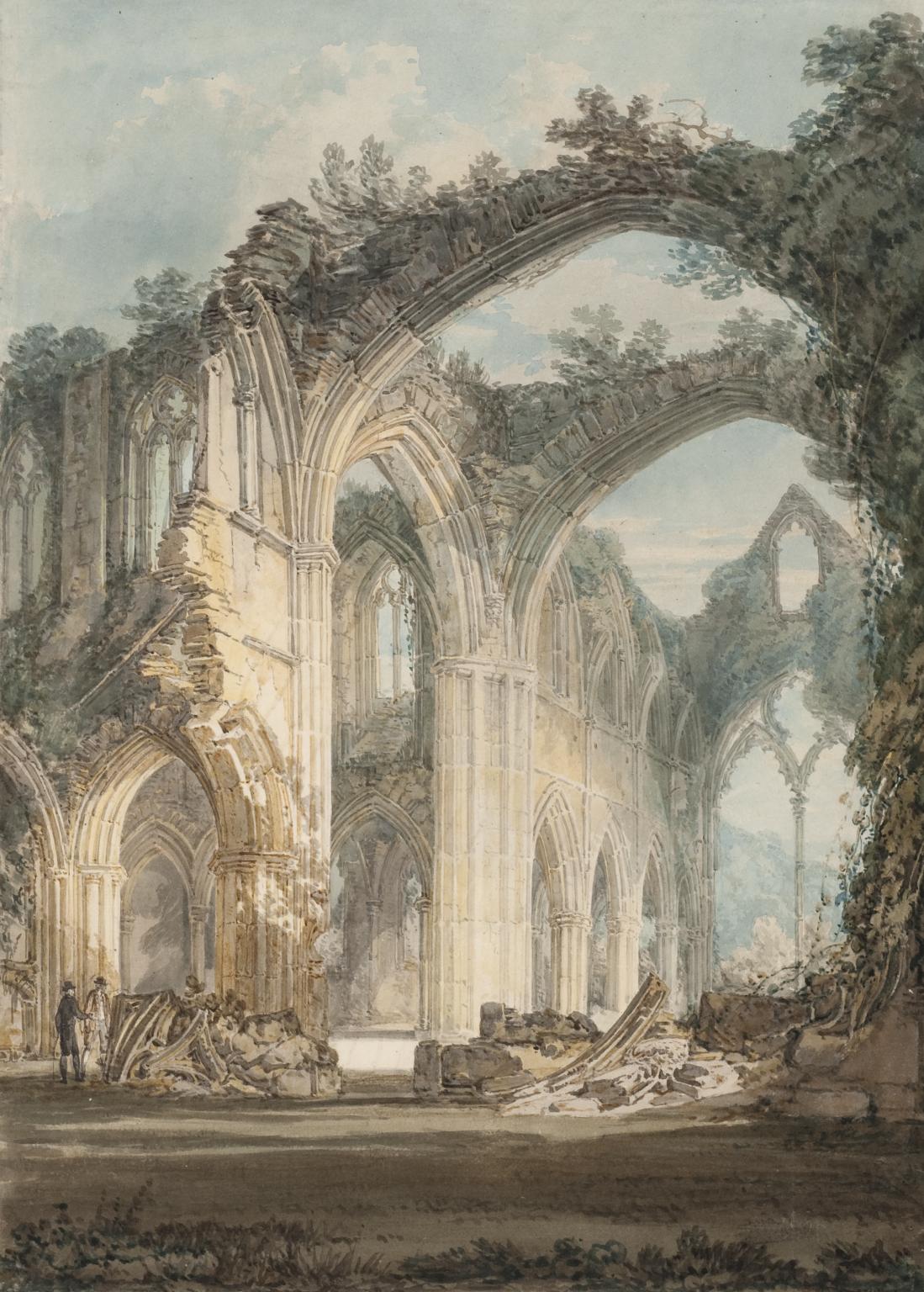
Fig. 17: Joseph Mallord William Turner, Tintern Abbey: The Crossing and Chancel, Looking towards the East Window (1794). Graphite and watercolour on paper. 359 x 250 mm. Tate Collection, London. Source: Wikimedia Commons (Public Domain).
35Throughout the game and TV adaptation, characters take shelter in ruins; while some communities manage to build stabler structures, ruin-dwelling becomes the norm for survivors. This echoes the Romantic sense of inhabiting the ruins of a greater civilisation, fostered in part by the rediscovery of antique sites in the eighteenth century. For the Romantics, nature itself also risked becoming a ruin under the pressure of industry. Environmental consciousness can be traced back to Romanticism, as the Romantics expressed anxiety over the Industrial Revolution’s defacement of the natural world; Blake, for one, warned against the “dark Satanic Mills” of industry consuming “Englands pleasant pastures.”63 The Last of Us presents the symmetrical opposite, a world where industry has receded, overtaken by the expansion of nature – restored as an awe-inspiring, primal force. Both the video game and the series give the audience time to take in those hybrid sceneries, dwelling on the beauty of the natural world. When the threat of the zombies is removed, a sense of serenity emerges (Fig. 18).64 Ultimately, the infected almost serve as a pretext to envision a world returned to wilderness. This is especially true of the TV series, whose first season minimizes the presence of the infected, opening space for numerous contemplative ruinscapes. The Last of Us is less a horror story than a story about the collapse of a world dominated by humans, and the adaptability of certain human beings in the face of this humbling reality. As such, the series bears the legacy of Romantic environmental consciousness.
Conclusion
36Environmental fiction offers a creative terrain for exploring the evolving relationship between the human and nonhuman worlds. Much like Romantic writers and artists who examined the boundaries between humans, plants, animals, and fungi, and found these boundaries to be flexible, such inquiries remain active today. Susannah Gibson points out the fluidity with which we now look at the natural world:
Today, scientists have moved on from the idea of three basic kingdoms and now recognize multiple groups of living things […] Today, the categories into which scientists fit species have become much more fluid and can be updated according to the latest findings in molecular taxonomy. These shifting boundaries show how quickly once-solid categories can be broken down, and illustrate just how complex the problem of defining a living being, let alone life, really is.65
37For all its classifications, the Romantic era was a period of awe in the face of nature, that probed its diversity and unpredictability. This Romantic sense of awe has endured in environmental fiction. The current environmental crisis forces us not only to renegotiate our interaction with the nonhuman world, but also to contemplate a future that might be posthuman. Examining the implications of ecological elegies – elegies for the environment – Timothy Morton highlights that the two primary ways of envisioning the outcome of the current climate crisis involve the death of humans:
Ecological apocalypticism warns against either total destruction, or against (or perversely, in favor of) life going on without us: against total death, or the death of us. In both instances, consciousness goes on – we always imagine total destruction from some impossible imaginary vantage point, a future anterior.66
38The Last of Us presents a different narrative. It is, after all, not “the death of us,” but rather “the last of us” that is imagined. Humans have not disappeared from the map, but they are made more vulnerable and flexible, subject to mutations. The narrative explores the hybridity so central to Romantic-era conceptions of the human and the nonhuman, offering a vision of the posthuman, not as a world devoid of humans, but as one in which humans strive to find their place within an interconnected ecosystem, much as the Romantics sought to do.
1 Theresa Kelley, Clandestine Marriage: Botany and Romantic Culture, Baltimore, Johns Hopkins University Press, 2012.
2 Susannah Gibson, Animal, Vegetable, Mineral? How Eighteenth-Century Science Disrupted the Natural Order, Oxford, Oxford University Press, 2015.
3 Erasmus Darwin, The Botanic Garden Part II., Containing The Loves of the Plants, A Poem with Philosophical Notes [1791], fourth edition, London, Joseph Johnson, 1794.
4 William Blake, The Complete Poetry and Prose of William Blake (1965), ed. by David Erdman, commentary by Harold Bloom, Berkeley, University of California Press, 1998. For Milton, p. 95-144. For Jerusalem, p. 144-259.
5 Percy Bysshe Shelley, Shelley’s Poetry and Prose: Authoritative Texts, Criticism, sel. and ed. by Donald H. Reiman and Sharon B. Powers, New York and London, Norton, 1977.
6 Terry Gifford, Pastoral, London, Routledge, 1999, p. 156, p. 161.
7 Theresa Kelley, op. cit., p. 5.
8 Theresa Kelley, op. cit., p. 39-40.
9 Theresa Kelley, op. cit., p. 61.
10 The spelling and punctuation follow Sowerby’s original text.
11 Theresa Kelley, op. cit., p. 61-62. The manuscript is indicated by Kelley to belong to the British Museum of Natural History, and is dated c. 1805-1809.
12 Theresa Kelley, op. cit., p. 61-62.
13 Susannah Gibson, op. cit., p. 180.
14 Erasmus Darwin, op. cit., p. 43. For clarity, Darwin’s long s (ſ) has been modernised as short s in this article.
15 Ibid.
16 Ibid.
17 Theresa Kelley, op. cit., p. 8.
18 Percy Bysshe Shelley, op. cit., p. 215.
19 Percy Bysshe Shelley, op. cit., p. 216-217.
20 Terry Gifford, op. cit., 156.
21 William Blake, op. cit., p. 41.
22 For an in-depth analysis of the links between the works of Erasmus Darwin and those of William Blake from an eco-critical perspective, see Caroline Dauphin’s doctoral thesis, “Eros et Uranie : passions animales et végétales dans la poésie d’Erasmus Darwin et de William Blake,” Université Sorbonne Nouvelle, defended 11 January 2021. Accessible here: https://theses.hal.science/tel-03482942
23 Blake was deeply inspired by neurology, an emerging discipline in the Romantic era. For more on Blake and neurology, see Tristane Connolly’s William Blake and the Body (Basingstoke, Palgrave Macmillan, 2002) as well as Richard Sha’s Science and Imagination in Romanticism (Baltimore, Johns Hopkins University Press, 2018).
24 William Blake, op. cit., p. 127.
25 William Blake, op. cit., p. 159.
26 Merlin Sheldrake, Entangled Life: How Fungi Make our Worlds, Change our Mind & Shape our Futures [2020], New York, Random House, 2021, p. 12.
27 William Blake, op. cit., p. 219.
28 William Blake, op. cit., p. 163.
29 For a closer analysis of the polyp in the works of William Blake and in the Romantic era, see Caroline Dauphin, op. cit., especially the section “Polypomania : une passion populaire,” p. 91-104.
30 Robert Southey, Sir Thomas More, Or, Colloquies on the Progress and Prospects of Society, vol. 1, London, John Murray, 1829, p. 171.
31 Herbert George Wells, The Time Machine [1895], The Centennial Edition, ed. by John Laton, London, Everyman, 1997, p. 28.
32 Merlin Sheldrake, op. cit., p. 10.
33 See Andrew Adamatzky, Jordi Vallverdu, Antoni Gandia, Alessandro Chiolerio, Oscar Castro, Gordana Dodig-Crnkovic, “Fungal Minds,” in Andrew Adamatzky (ed.), Fungal Machines. Emergence, Complexity and Computation, Springer, Cham, 2023, vol. 47, p. 409-422 https://doi.org/10.1007/978-3-031-38336-6_26
34 Anna Lowenhaupt Tsing, The Mushroom at the End of the World: On the Possibility of Life in Capitalist Ruins, Princeton, Princeton University Press, 2015.
35 Anna Lowenhaupt Tsing, op. cit., p. 160.
36 HBO TV series, 2023, Opening credits, 0:09. Hyperlink: https://youtu.be/8SWhBsbxmpk?si=nW7fQi6qefGChj7X&t=9
37 HBO TV series, 2023, Opening credits, 0:36. Hyperlink: https://youtu.be/8SWhBsbxmpk?si=9AXwDQ1EjivVKXcQ&t=36
38 HBO TV series, 2023, Opening credits, 0:54. Hyperlink: https://youtu.be/8SWhBsbxmpk?si=xwZMAXUHsBQQFMfg&t=54 . In the second season, the credits are adapted after Joel’s death, showing only the silhouette of Ellie.
39 Anna Lowenhaupt Tsing, op. cit., p. vii.
40 Merlin Sheldrake, op. cit., p. 105.
41 Merlin Sheldrake, op. cit., p. 105.
42 “The Last of Us Developers on Clicker Creation, HBO Producers on Adapting TLOU Action,” (1:35). Hyperlink: https://youtu.be/iNzLOyp4rA0?si=btCbl2WfMlNUsvSC&t=95
43 “The Last of Us Developers on Clicker Creation, HBO Producers on Adapting TLOU Action,” (2:41). Hyperlink: https://youtu.be/iNzLOyp4rA0?si=irmCAdgODDWqguwV&t=161
44 “How The Last of Us SFX Artists Created the ‘Infected,’” (1:27). Hyperlink: https://youtu.be/4WrbIfBm0Mk?si=Nh9t6EC_TLnMFfBi&t=87
45 “How The Last of Us SFX Artists Created the ‘Infected,’” (1:38). Hyperlink: https://youtu.be/4WrbIfBm0Mk?si=Z6a7MA5gU7VBcob3&t=98
46 “How The Last of Us SFX Artists Created the ‘Infected,’” (4:34-43), link: https://youtu.be/4WrbIfBm0Mk?si=qGOJPDFN-06K3paW&t=274
47 Merlin Sheldrake, op. cit., p. 9.
48 “How The Last of Us SFX Artists Created the ‘Infected,’” (2:38). Hyperlink: https://youtu.be/4WrbIfBm0Mk?si=CRbljywHllEUIVIg&t=158
49 Merlin Sheldrake, op. cit., p. 50.
50 Merlin Sheldrake, op. cit., p. 151.
51 See for instance Philip James de Loutherbourg’s Coalbrookdale by Night (1801).
52 Terry Gifford, “Pastoral, Antipastoral, and Postpastoral as Reading Strategies,” in Scott Slovic (ed.), Nature and the Environment, Ipswich, Salem Press, “Critical Insights,” 2013, p. 42-61.
53 Terry Gifford, Pastoral, op. cit., p. 151-52.
54 Ibid., p. 153.
55 Ibid., p. 156.
56 Ibid., p. 161.
57 Ibid., p. 163.
58 “The Last of Us Developers, HBO Creators on Building the World Around Joel and Ellie,” (00:11-00:18), https://youtu.be/ZNqYXxRoYJM?si=Cn00iS2a8_KUvxbK&t=11
59 “The Last of Us Developers, HBO Creators on Building the World Around Joel and Ellie,” (1:17-1:52), https://youtu.be/ZNqYXxRoYJM?si=X-oeP31cBSC3oa2d&t=77
60 “The Last of Us – announcement trailer official HD,” (2:23). Hyperlink: https://youtu.be/mJt-mlLk10k?si=1Hc5xa7QhrcDg-H7&t=143
61 “The Last of Us Developers, HBO Creators on Building the World Around Joel and Ellie,” (5:23). Hyperlink : https://youtu.be/ZNqYXxRoYJM?si=FVD_OPOuefQVB0Ni&t=323
62 “The Last of Us Developers, HBO Creators on Building the World Around Joel and Ellie,” (3:21). Hyperlink: https://youtu.be/ZNqYXxRoYJM?si=8iur7hFzNOxH2wPQ&t=201
63 William Blake, op. cit., p. 95.
64 “The Last of Us – Story Trailer Cutdown,” (0:04). Hyperlink: https://youtu.be/1gj4i4vnOT0?si=xezW45FlWypTrkGl&t=4
65 Susannah Gibson, op. cit., p. 179-80.
66 Timothy Morton, “The Dark Ecology of Elegy,” in Karen Weisman (ed.), The Oxford Handbook of the Elegy, Oxford, Oxford University Press, 2010, p. 251-271 (p. 254).

Ce(tte) œuvre est mise à disposition selon les termes de la Licence Creative Commons Attribution - Pas dUtilisation Commerciale - Partage dans les Mêmes Conditions 4.0 International. Polygraphiques - Collection numérique de l'ERIAC EA 4705
URL : https://publis-shs.univ-rouen.fr/eriac/1124.html.
Quelques mots à propos de : Camille Adnot
Camille Adnot is Lecturer in English literature at École Normale Supérieure PSL, and a member of the research unit “République des Savoirs” (UMR 8241). Her research explores 18th- and 19th-century literature and visual arts, with a focus on Romanticism approached through material and ecological perspectives. She is preparing a monograph on William Blake’s illuminated books, building on her doctoral thesis defended at Université Paris Cité in 2023. Her recent publications include chapters in Water and Sea in Word and Image (Brill, 2023), Milton Across Borders and Media (OUP, 2023), Global Bunyan and Visual Art (Bloomsbury, 2025), and Apocalypse: Hier et demain (BnF, 2025). Since 2021, she has been co-hosting ‘Romanticism Across Borders,’ a cross-university, online seminar which fosters transversal approaches to the Romantic period.